CEC, Bokashi & EM: Building Soil Fertility from the Microbial Level Up
How Effective Microorganisms, Bokashi – and CEC Saturation – Redefine Nutrient Management
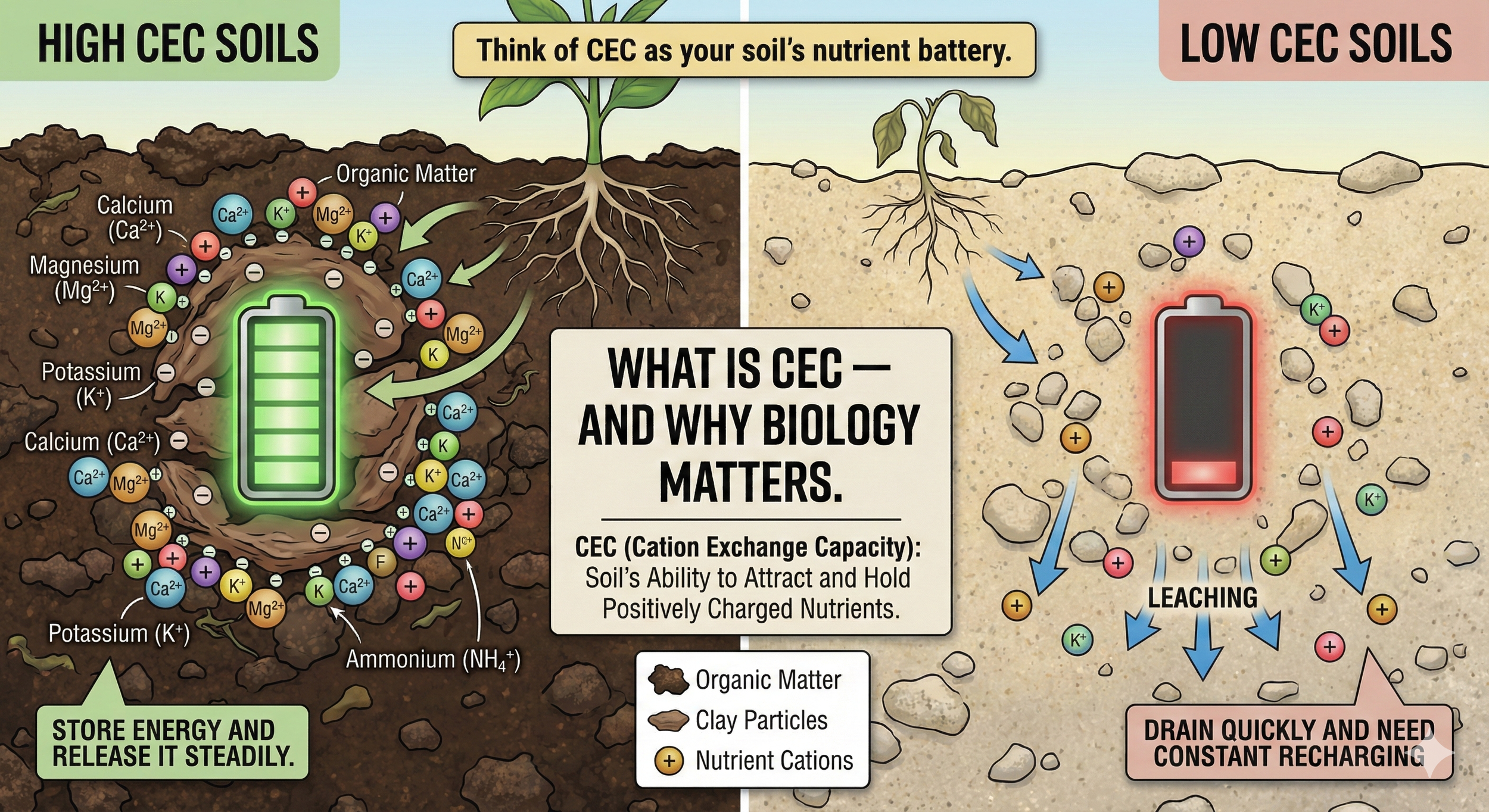
When we talk about healthy soil, the conversation usually starts with nutrients: nitrogen, phosphorus, potassium. But beneath those numbers sits something far more fundamental — Cation Exchange Capacity (CEC).
CEC determines how well soil can hold onto nutrients, buffer pH, manage moisture, and support resilient plant growth. And crucially, it shapes whether the nutrients you apply are actually useful — or simply lost.
This is where Effective Microorganisms (EM) and Bokashi fermentation quietly do some of their most powerful work.
Bokashi: Fermentation That Feeds CEC
Bokashi is not compost in the traditional sense. It’s a controlled fermentation process, driven by lactic acid bacteria, yeasts, and photosynthetic bacteria. Instead of oxidising organic matter, Bokashi pre-digests nutrients and stabilises carbon.
When Bokashi material enters soil:
Organic matter is already partially stabilised
Carbon compounds bind rapidly to clay and mineral surfaces
Nutrients are held in exchangeable (CEC-active) forms
These processes create humus precursors — the very compounds responsible for long-term CEC development.
Put simply:
Bokashi builds the framework that CEC depends on.
EM and the Living Charge of Soil
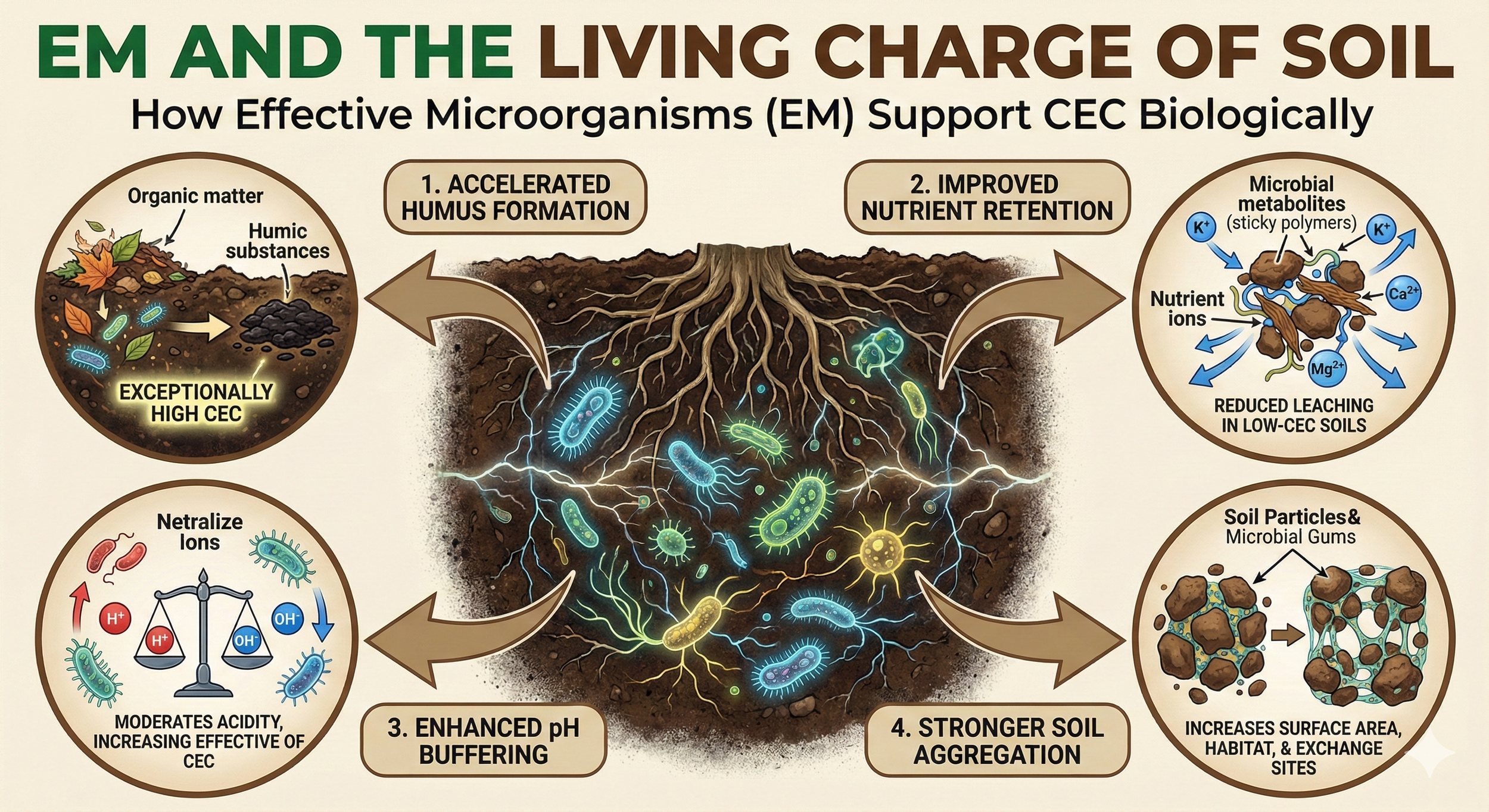
Effective Microorganisms don’t directly “add” CEC — but they unlock and multiply its function.
How EM supports CEC biologically:
1. Accelerated humus formation
EM speeds the conversion of organic inputs into stable humic substances. Humus has an exceptionally high CEC — far higher than clay alone.
2. Improved nutrient retention
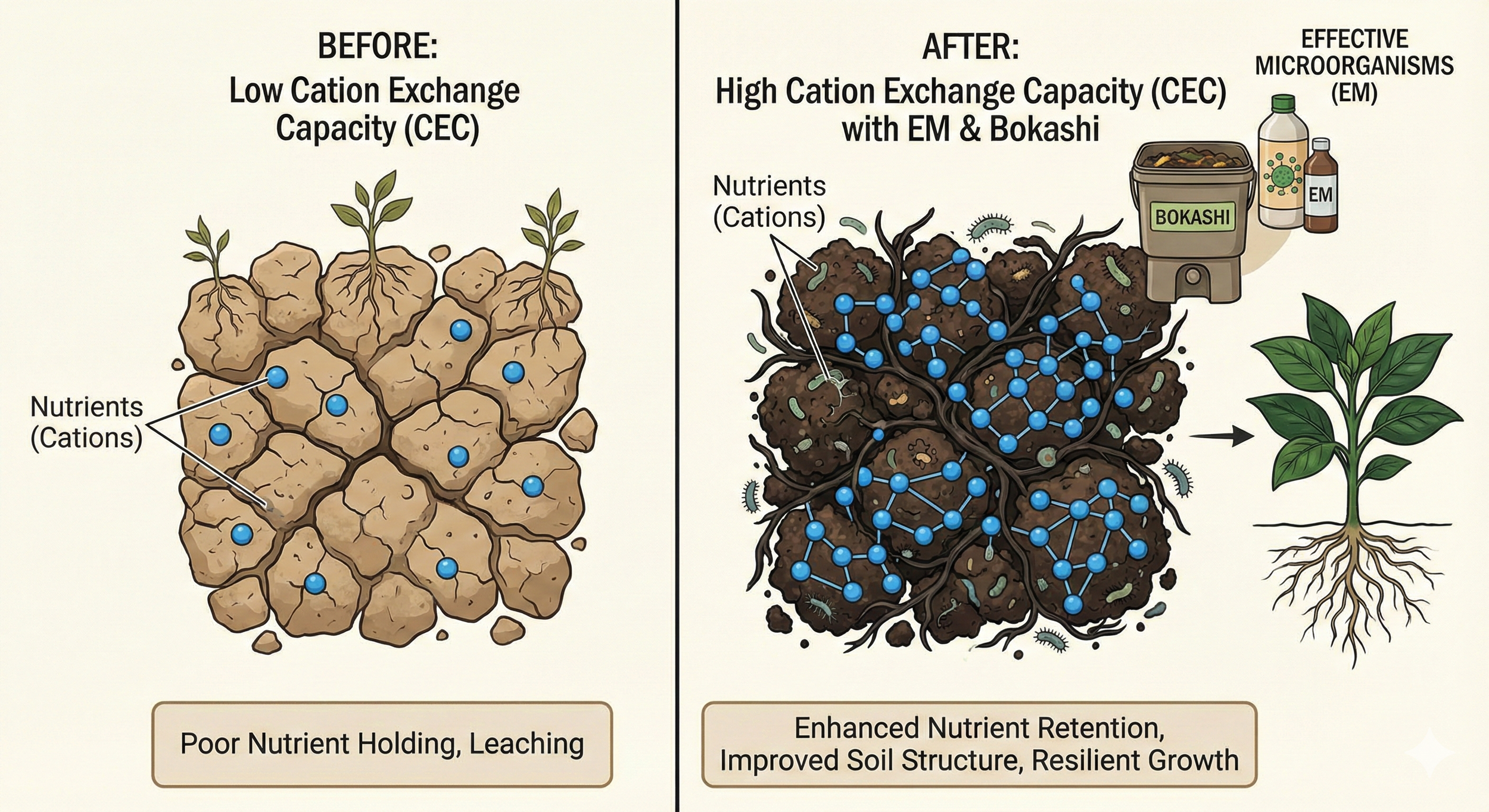
Microbial metabolites bind nutrients to organic and mineral surfaces, reducing leaching in low-CEC soils such as sands.
3. Enhanced pH buffering
Biological activity moderates acidity and alkalinity, increasing effective CEC, especially in acidic or degraded soils.
4. Stronger soil aggregation
Better aggregation increases surface area, microbial habitat, and nutrient exchange sites.
Why Bokashi + EM Are Especially Powerful Together
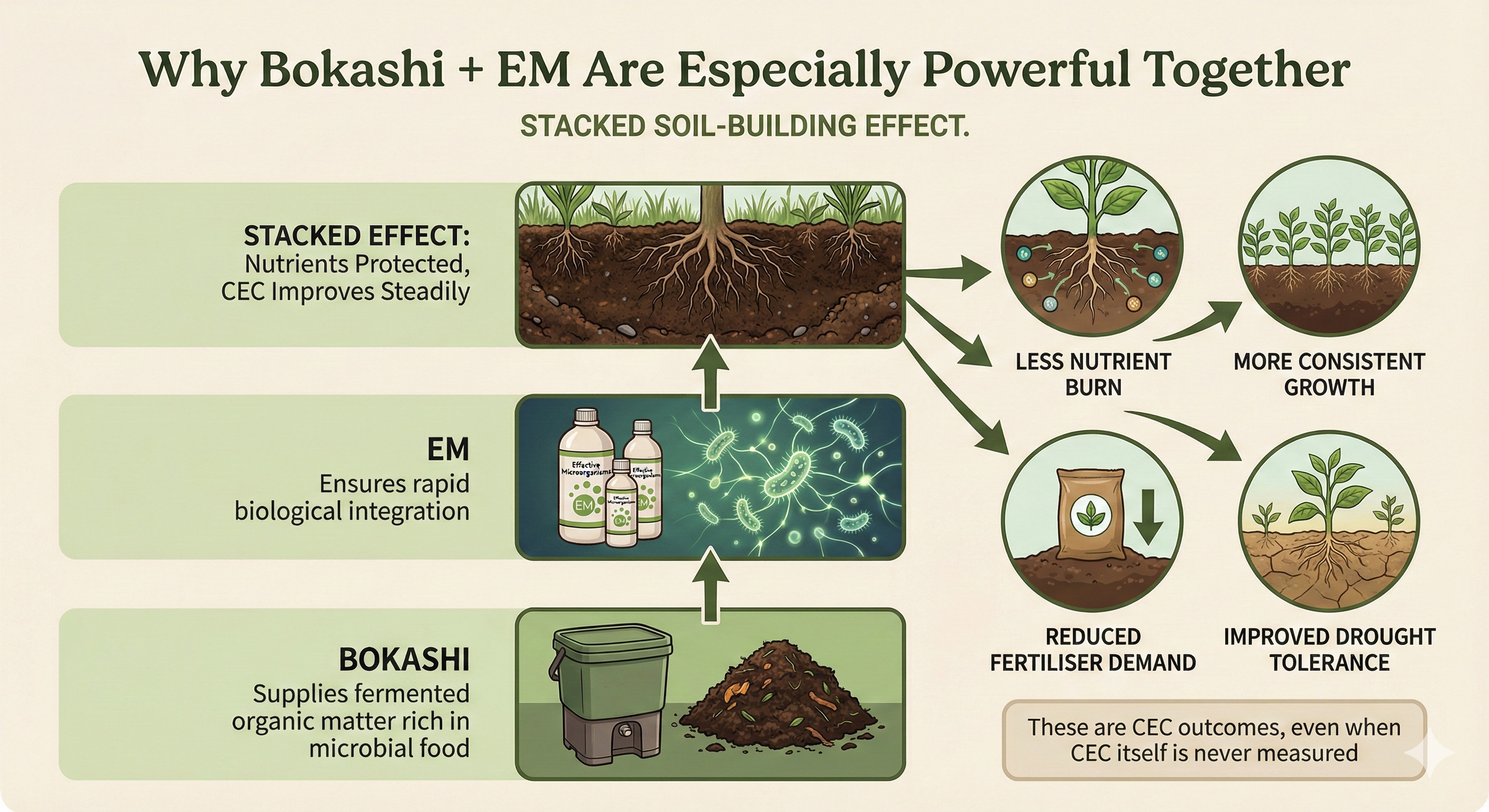
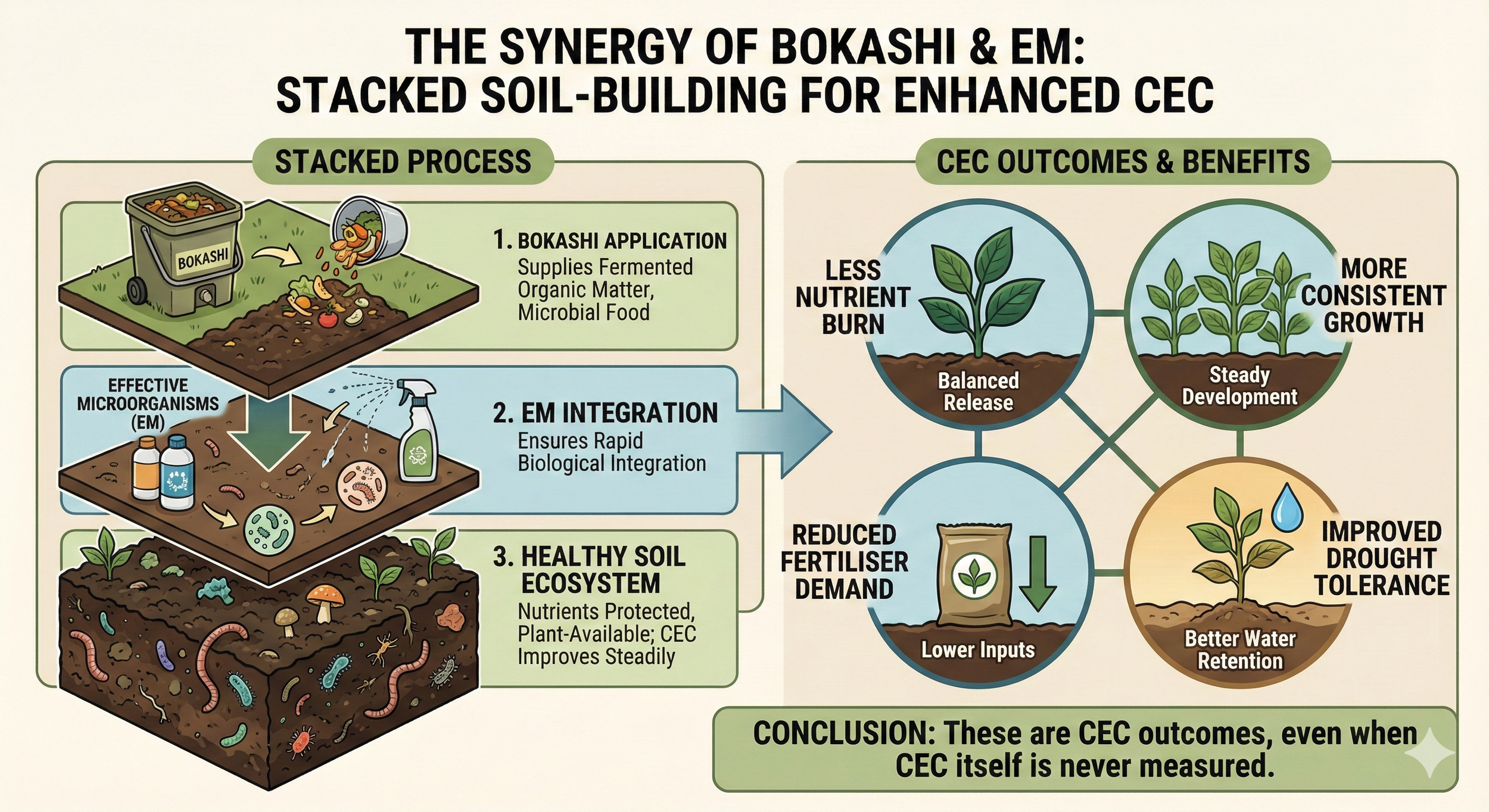
Used together, Bokashi and EM create a stacked soil-building effect:
Bokashi supplies fermented organic matter rich in microbial food
EM ensures rapid biological integration
Nutrients remain plant-available but protected from loss
CEC improves steadily, not temporarily
This is why growers often report:
Less nutrient burn
More consistent growth
Reduced fertiliser demand
Improved drought tolerance
These are CEC outcomes, even when CEC itself is never measured.
CEC in Low-Input vs High-Input Systems
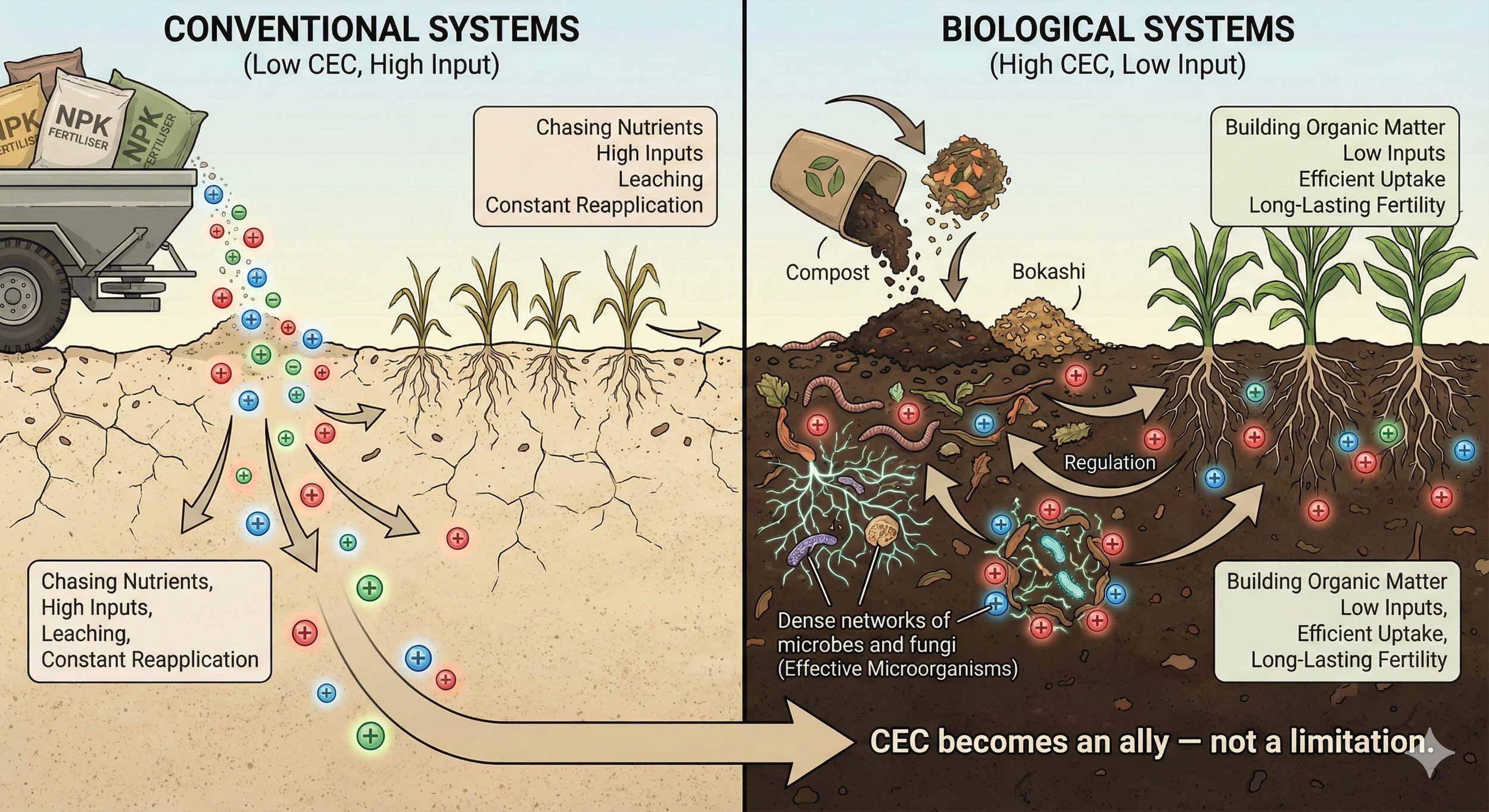
Conventional systems often chase nutrients in low-CEC soils, applying more fertiliser to compensate for losses.
Biological systems using EM and Bokashi flip the logic:
Build organic matter first
Increase nutrient holding capacity
Let biology regulate release
The result is fewer inputs, better uptake, and longer-lasting fertility.
CEC becomes an ally — not a limitation.
The Missing Piece: CEC Saturation
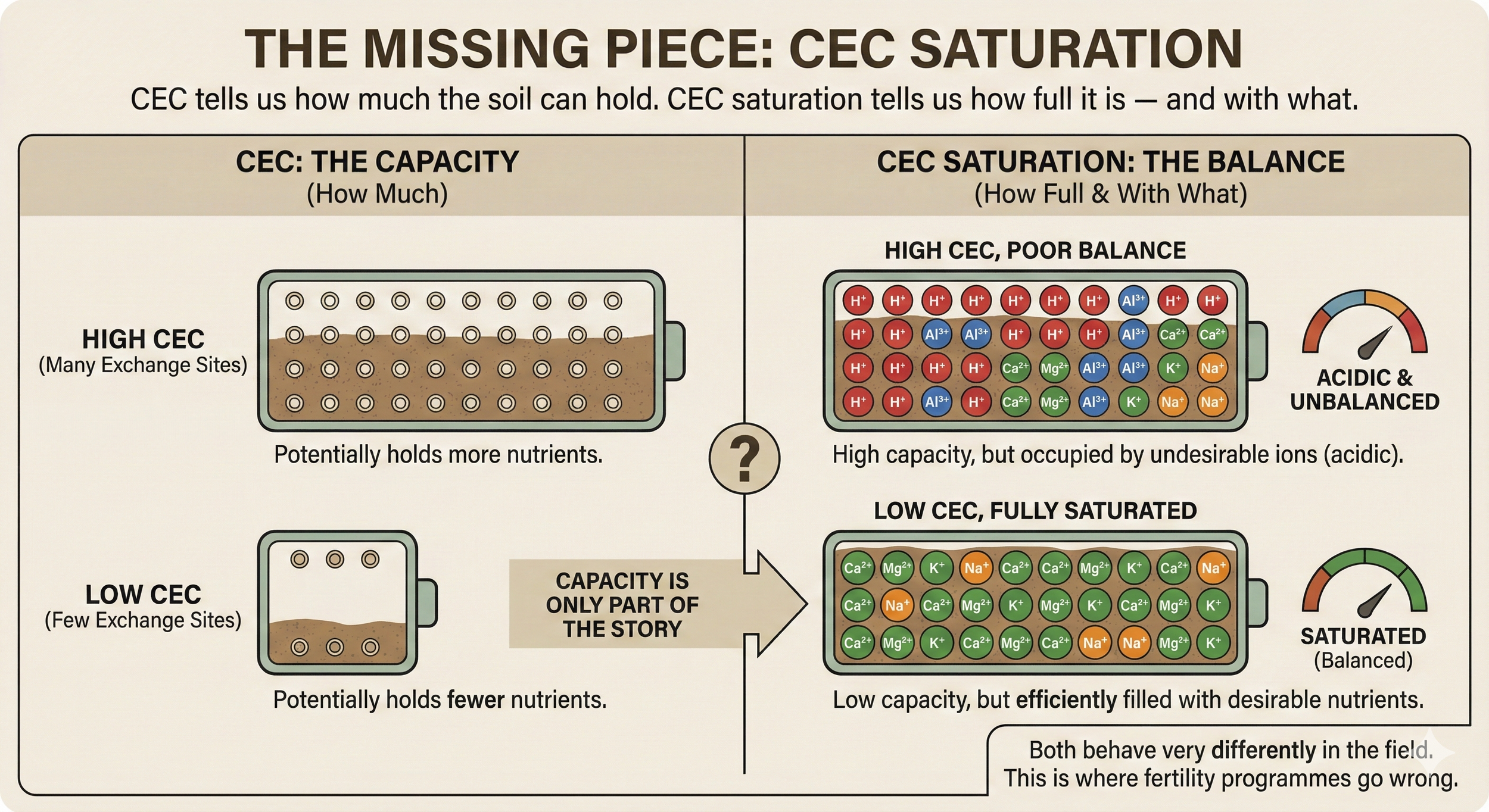
CEC tells us how much the soil can hold.
CEC saturation tells us how full it already is — and with what.
This is where many fertility programmes go wrong.
What Is CEC (Base) Saturation?
CEC saturation (often called base saturation) describes how exchange sites are occupied, typically by:
Calcium (Ca²⁺)
Magnesium (Mg²⁺)
Potassium (K⁺)
Sodium (Na⁺)
Hydrogen (H⁺) and aluminium (Al³⁺) in acidic soils
A soil can have:
High CEC, poor balance, or
Low CEC, but be fully saturated
Both behave very differently in the field.
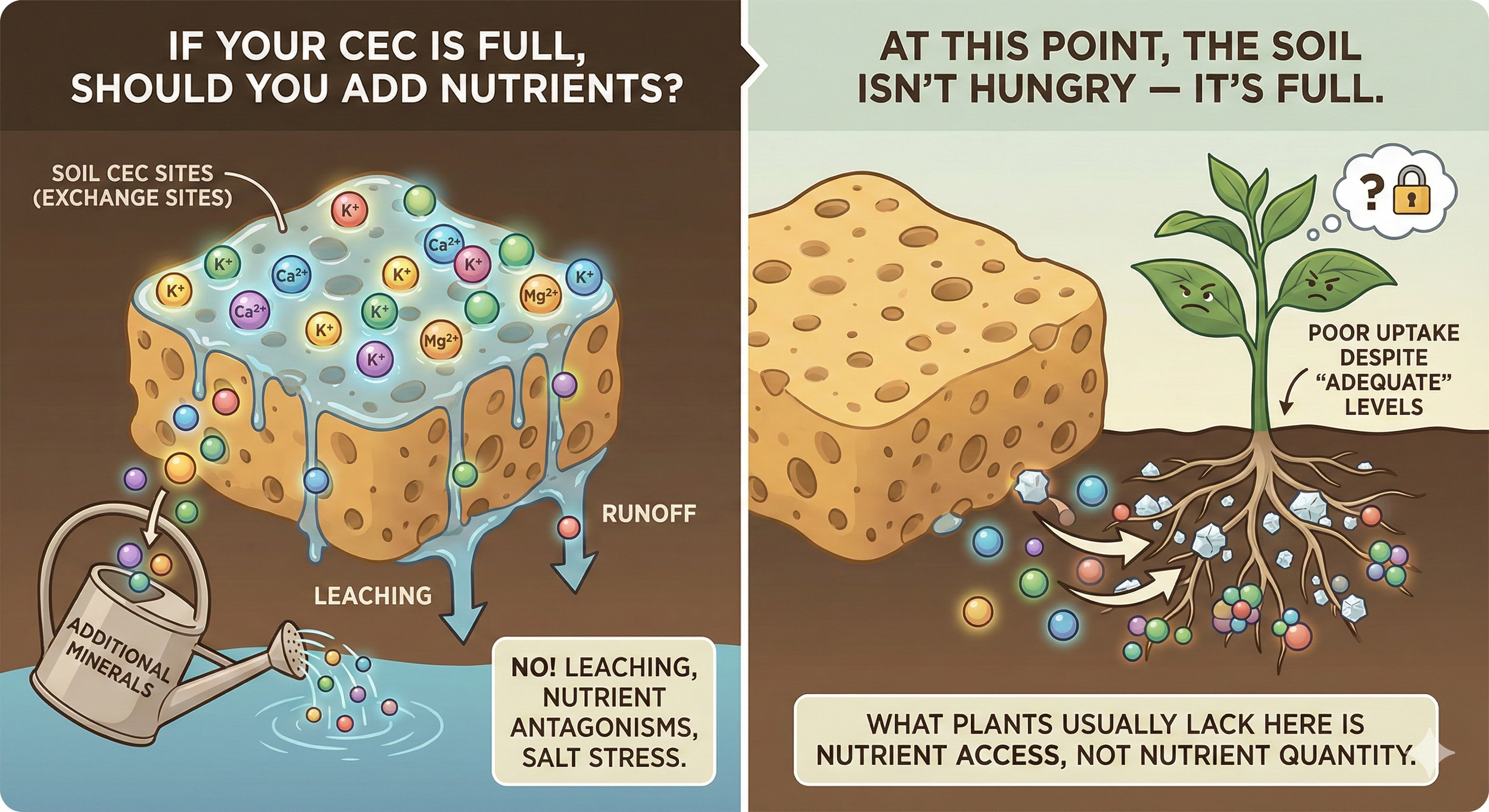
If Your CEC Is Full, Should You Add Nutrients?
Short answer: usually no — at least not as soil-applied minerals.
When exchange sites are already occupied, additional nutrients often lead to:
Leaching
Nutrient antagonisms
Rising EC and salt stress
Poor uptake despite “adequate” soil test levels
At this point, the soil isn’t hungry — it’s full.
What plants usually lack here is nutrient access, not nutrient quantity.
Where EM and Bokashi Change the Conversation
This is where biological management becomes essential.
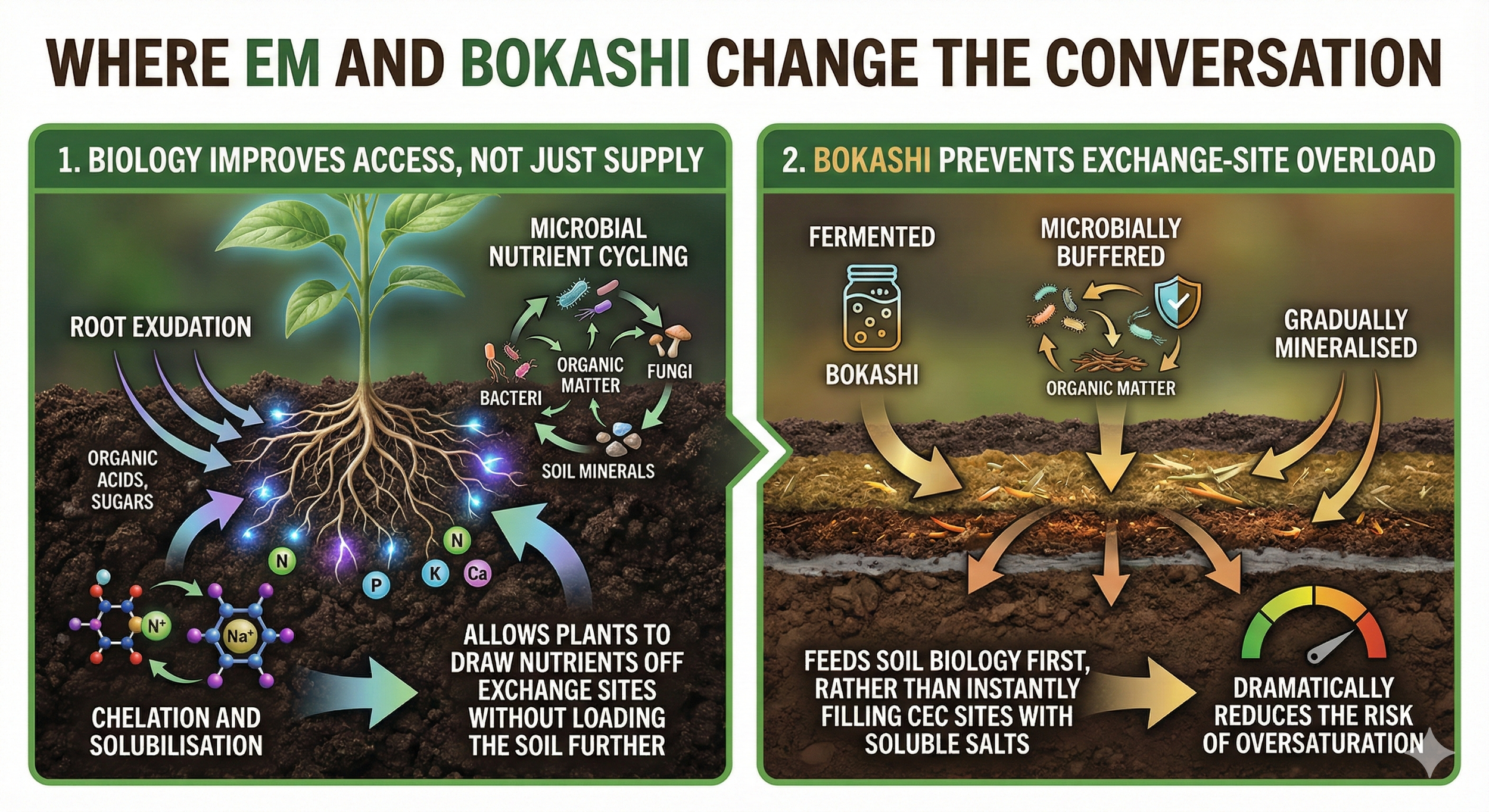
1. Biology Improves Access, Not Just Supply
EM-driven systems enhance:
Root exudation
Microbial nutrient cycling
Chelation and solubilisation
This allows plants to draw nutrients off exchange sites without loading the soil further.
2. Bokashi Prevents Exchange-Site Overload
Because Bokashi inputs are:
Fermented
Microbially buffered
Gradually mineralised
They feed soil biology first, rather than instantly filling CEC sites with soluble salts. This dramatically reduces the risk of oversaturation.
When Adding Nutrients Is Counterproductive
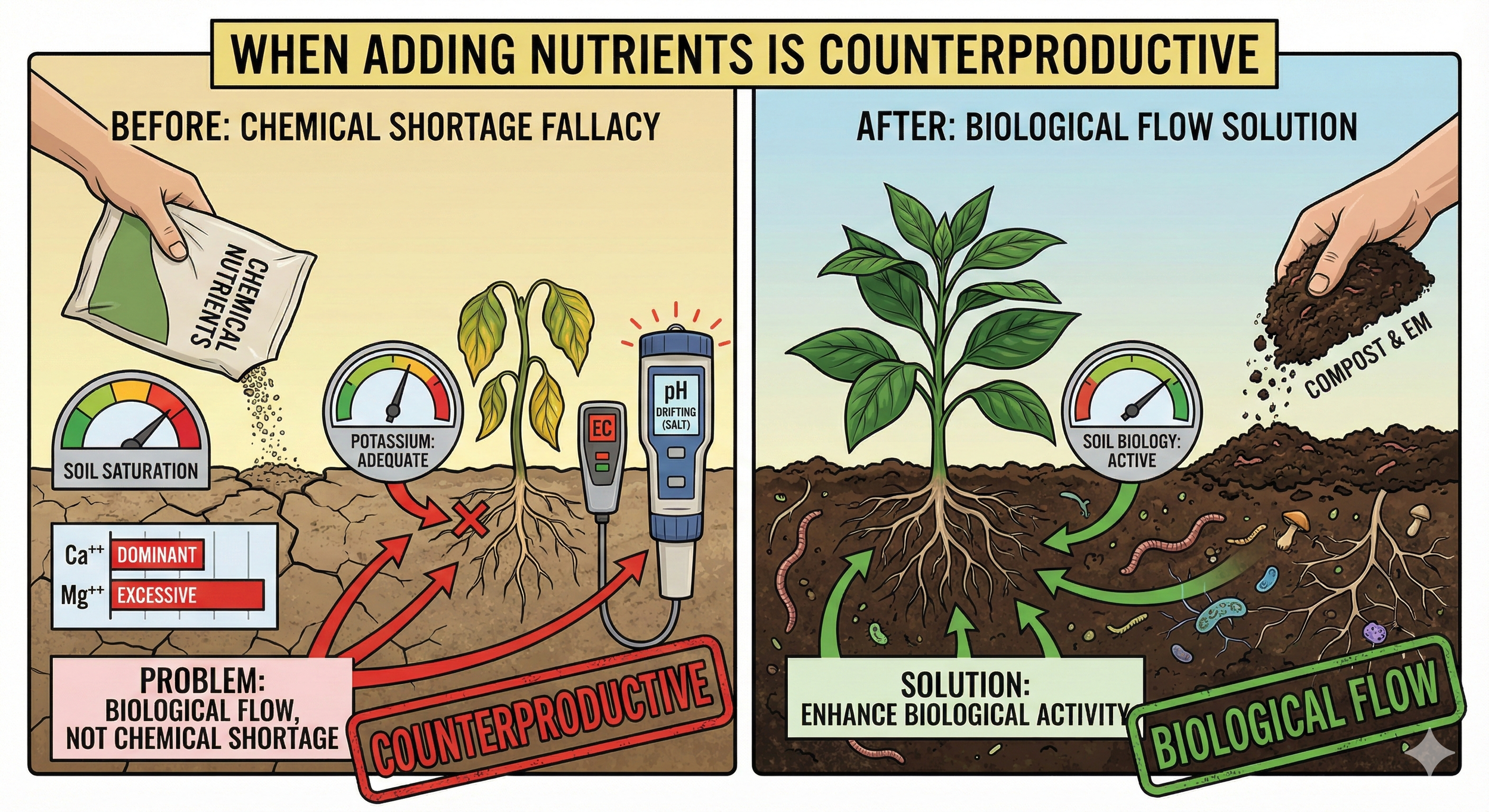
Soil-applied nutrients are often unnecessary — or harmful — when:
Base saturation is already high
Calcium dominates but magnesium is excessive
Potassium levels test “adequate” but uptake is poor
EC is rising
pH is drifting due to salt accumulation
In these cases, the problem is almost always biological flow, not chemical shortage.
What to Do Instead When CEC Is Full
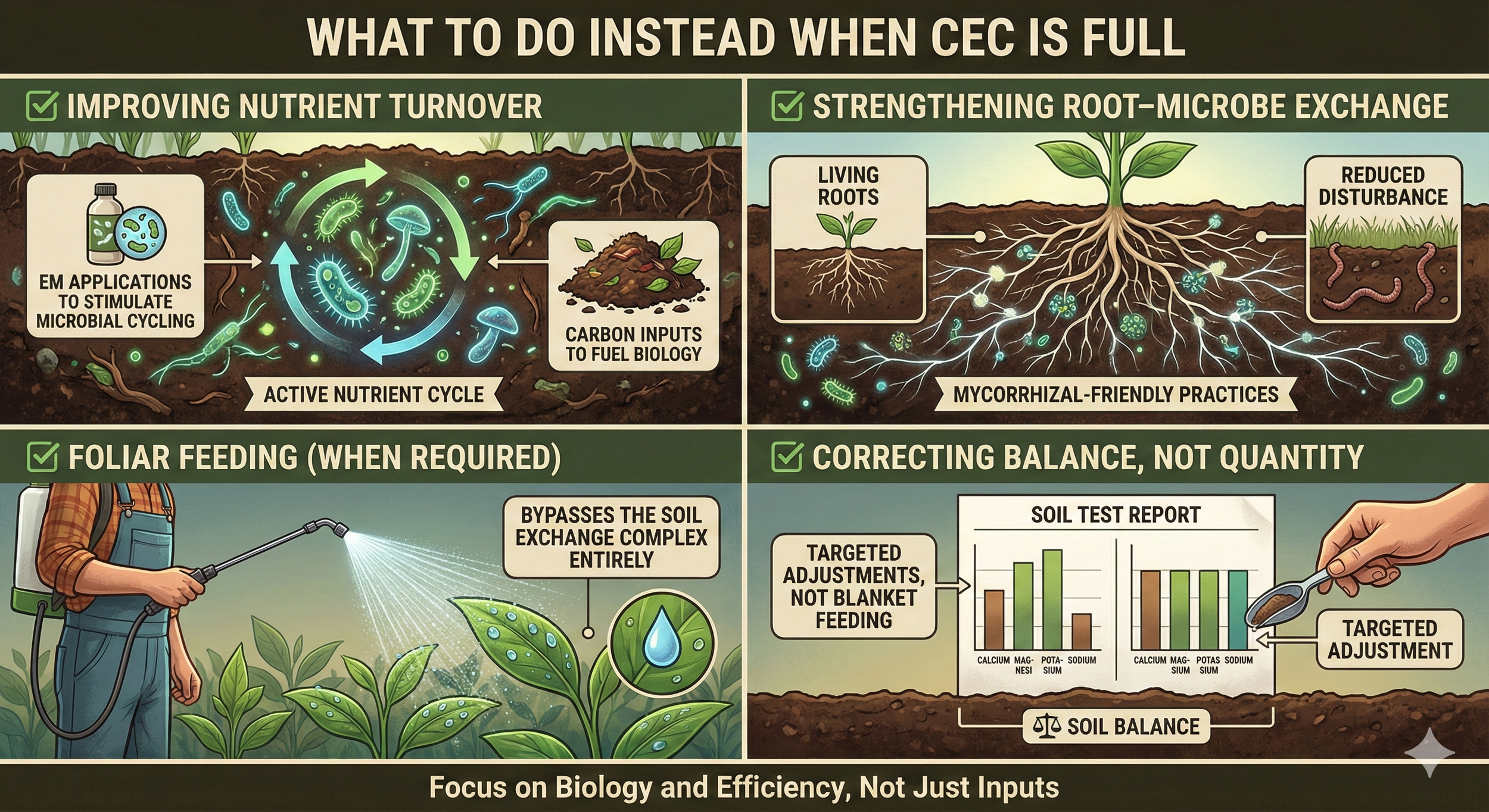
Rather than adding more nutrients, focus on:
✅ Improving nutrient turnover
EM applications to stimulate microbial cycling
Carbon inputs to fuel biology
✅ Strengthening root–microbe exchange
Living roots
Reduced disturbance
Mycorrhizal-friendly practices
✅ Foliar feeding (when required)
Bypasses the soil exchange complex entirely
✅ Correcting balance, not quantity
Targeted adjustments, not blanket feeding
Simple Analogy
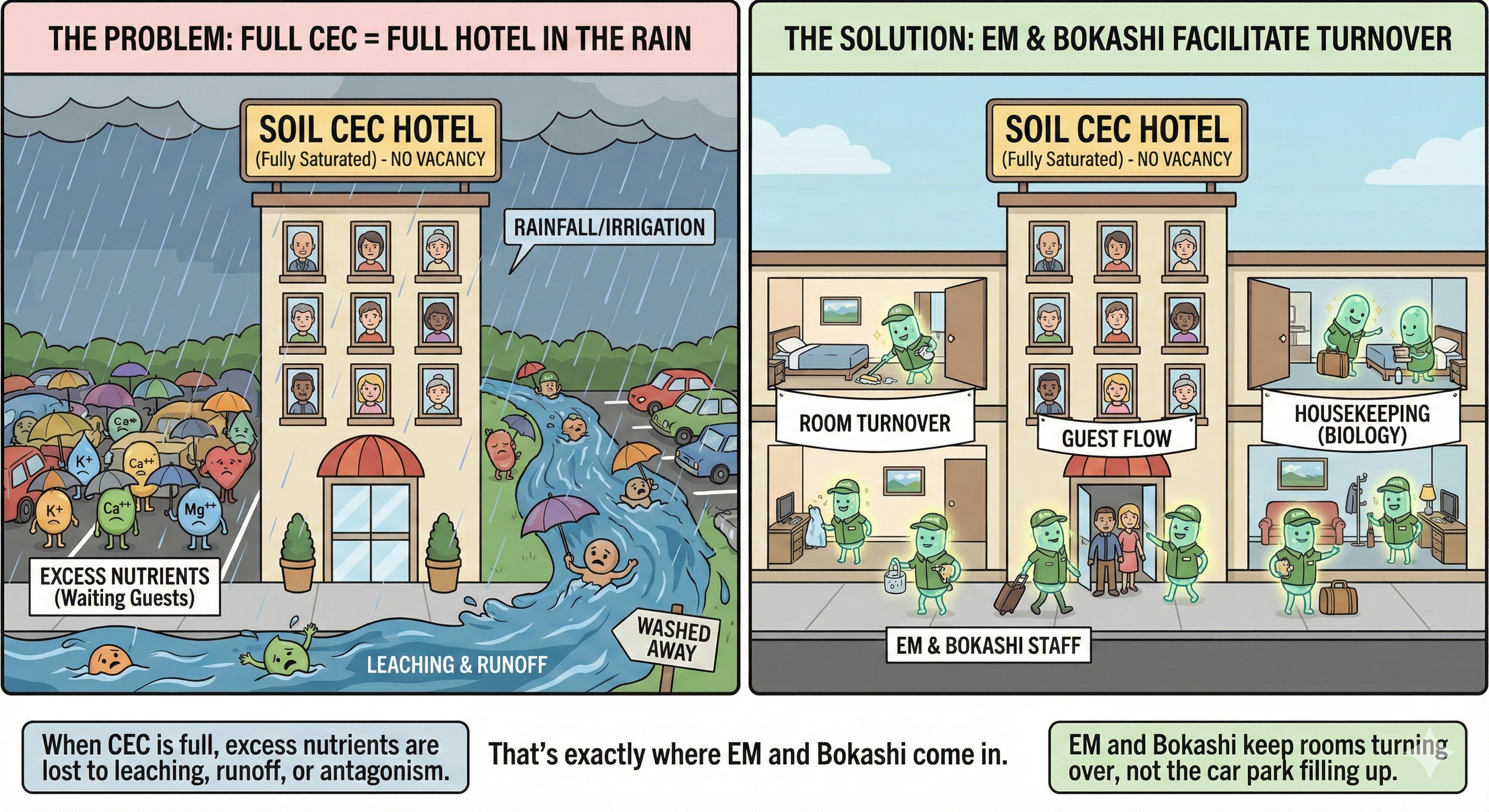
CEC as a Fully Booked Hotel — with Rain in the Car Park
Think of CEC like a fully booked hotel.
All the rooms are occupied — that’s CEC saturation.
Adding more guests doesn’t help. They either:
Wait in the car park
Or leave altogether
Now imagine it starts raining heavily.
Those guests stuck in the car park don’t suddenly get rooms — they get washed away.
That rain is irrigation or rainfall.
Those guests are excess nutrients.
If your CEC is full, any additional nutrients applied to the soil aren’t stored — they’re lost to leaching, runoff, or antagonism.
What matters now isn’t more guests — it’s:
Room turnover
Guest flow
Housekeeping (biology)
That’s exactly where EM and Bokashi come in.
They keep rooms turning over, not the car park filling up.
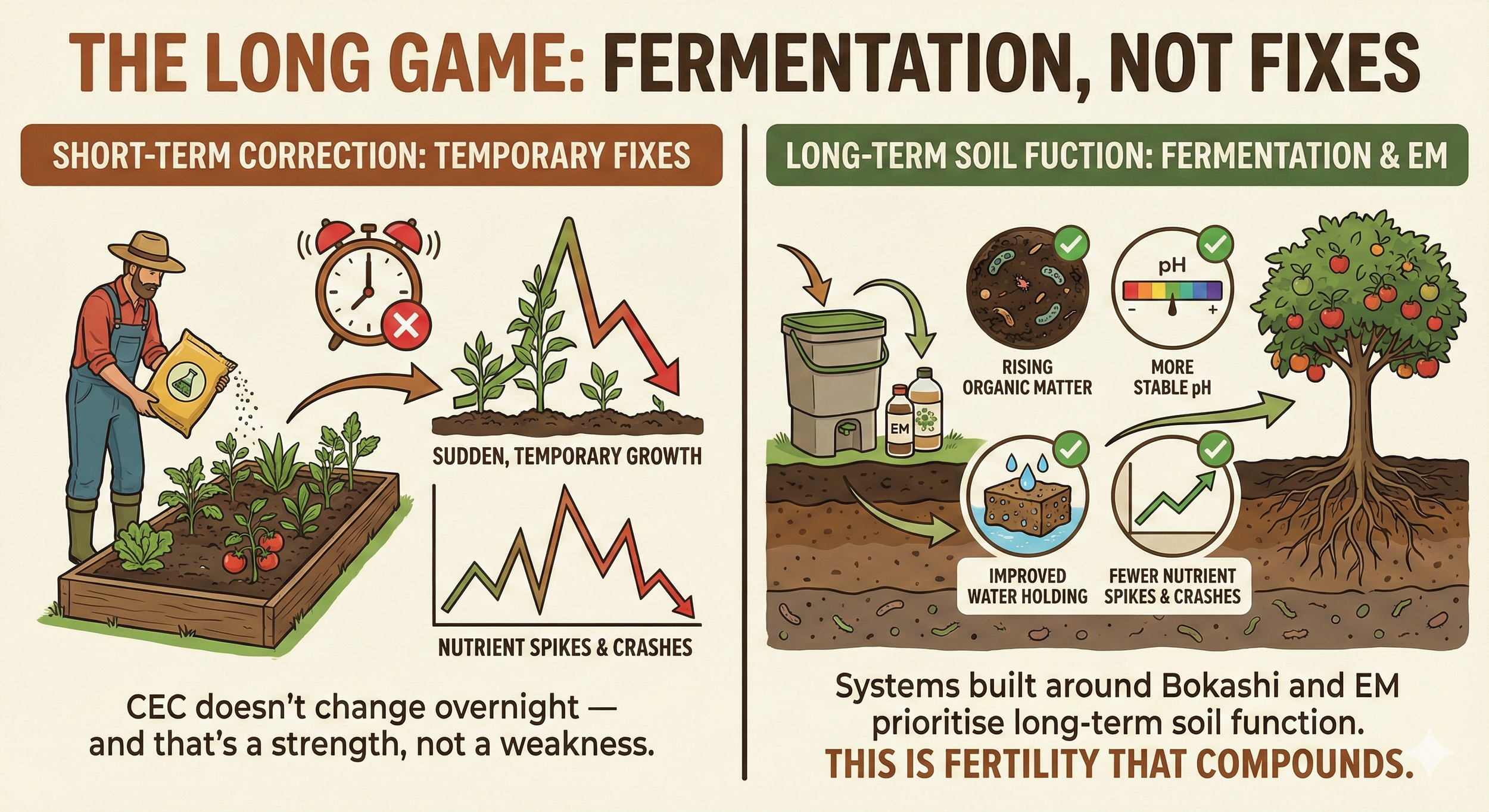
The Long Game: Fermentation, Not Fixes
CEC doesn’t change overnight — and that’s a strength, not a weakness. Systems built around Bokashi and EM prioritise long-term soil function, not short-term correction.
Over time, growers see:
Rising organic matter
More stable pH
Improved water holding
Fewer nutrient spikes and crashes
This is fertility that compounds.
Final Takeaway
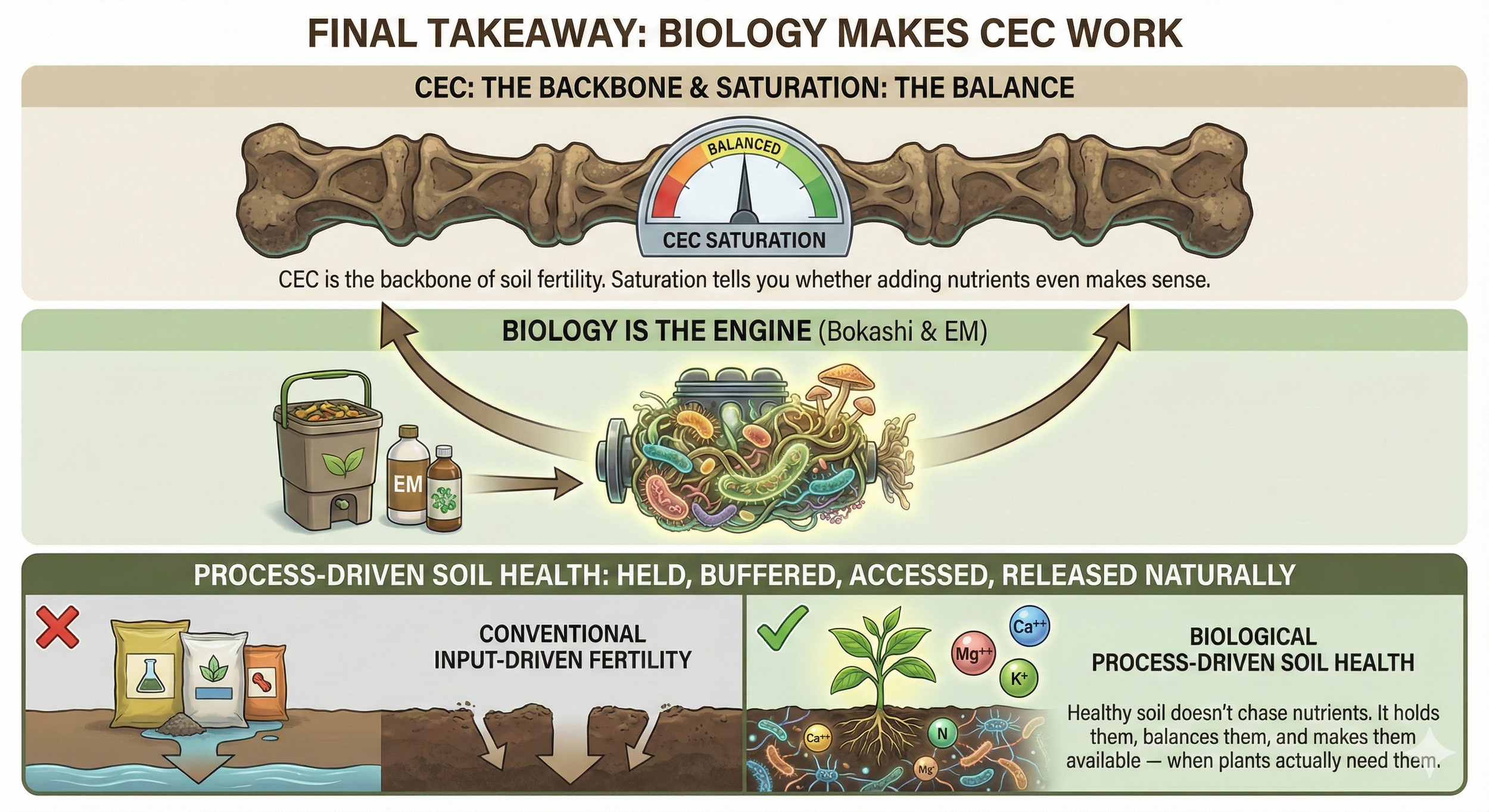
CEC is the backbone of soil fertility.
CEC saturation tells you whether adding nutrients even makes sense.
Biology is the engine that makes both work.
By combining Bokashi fermentation with Effective Microorganisms, you move from input-driven fertility to process-driven soil health — where nutrients are held, buffered, accessed, and released naturally.
Healthy soil doesn’t chase nutrients.
It holds them, balances them, and makes them available — when plants actually need them.