
The Market Garden Drought Problem Starts in the Soil
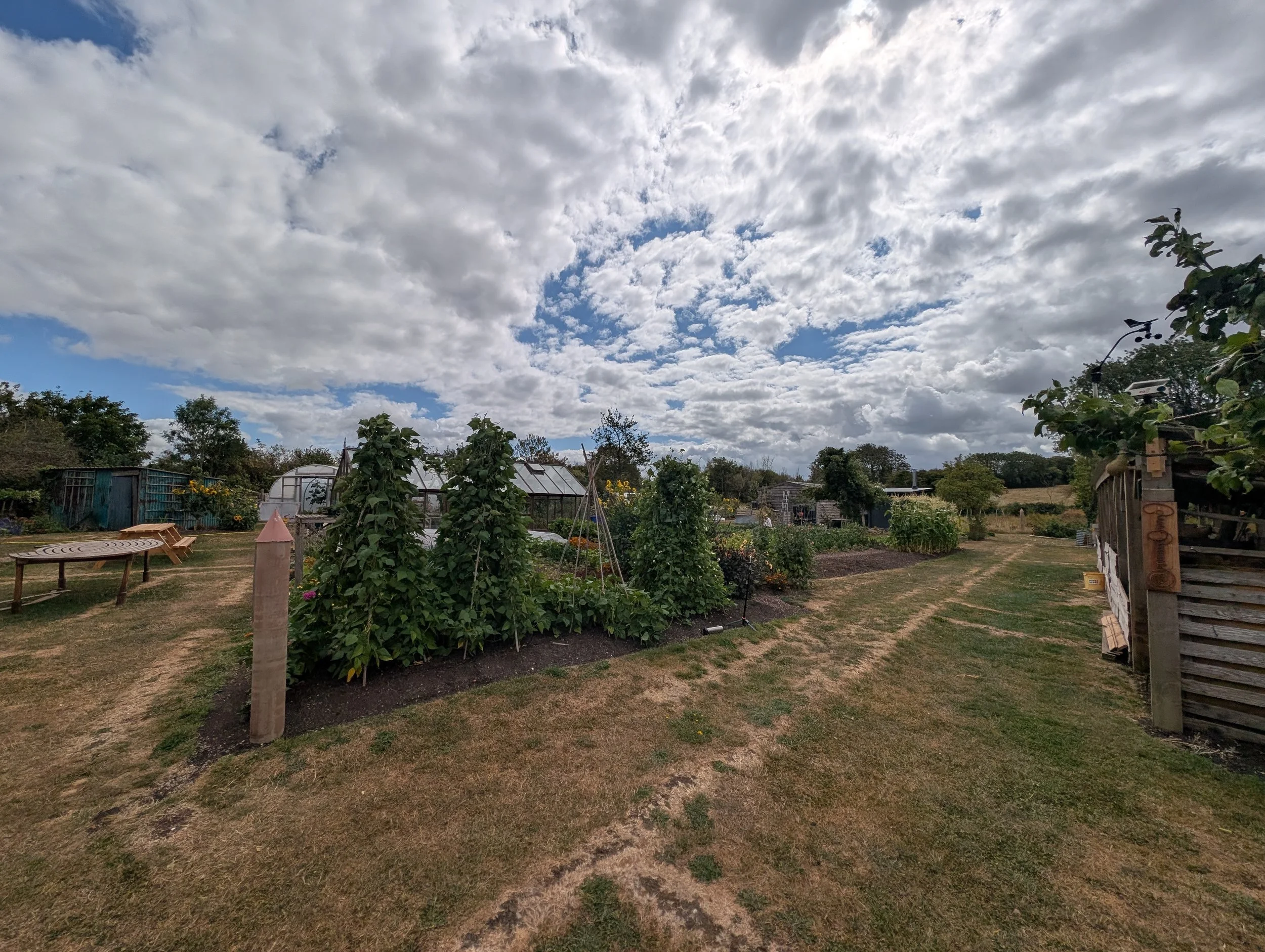
Market garden examining healthy soil in productive vegetable beds during a dry summer.
For many market gardeners, the conversation around soil is changing.
For years, the question was largely:
What does this crop need to grow?
Increasingly, another question is becoming just as important:
What does this soil need to keep growing crops when the rain stops?
That distinction matters.
A market garden can have an irrigation system, fertility plan and beautifully prepared beds, but if the soil has poor structure, low organic matter and limited biological activity, water can disappear remarkably quickly.
During prolonged dry weather, irrigation can start to feel less like a useful tool and more like life support.
And this is where an important five-year research programme from the Netherlands becomes particularly interesting.
Between 2021 and 2026, Wageningen University & Research, supported by HAS Green Academy and Van Hall Larenstein University of Applied Sciences, investigated whether locally available organic materials such as roadside grass cuttings and leaves could be turned into useful Local Soil Improvers.
Around 60 practical pilots were involved, alongside controlled field trials at three WUR research farms.
The programme investigated Bokashi, locally produced compost, treated grass cuttings, untreated cuttings and conventional green compost.
What started as a question about turning "waste" into a useful agricultural resource became a much bigger investigation into organic matter, soil biology, nutrient cycling and ultimately the resilience of soil itself.
Drought changes what we should expect from our soil
This wasn't specifically a British market-garden trial, and we shouldn't pretend it was.
But the implications for intensive vegetable production are difficult to ignore.
Market gardens ask a huge amount from relatively small areas of soil. Crops are planted, harvested and replanted repeatedly. Organic material and nutrients continually leave the system in the form of vegetables.
At the same time, increasingly dry growing periods can place enormous pressure on irrigation.
The answer cannot simply be more water.
We also need soil capable of receiving that water, storing it and making it available to roots.
And that brings us to one of the most important subjects in the Wageningen report: organic matter.
The researchers describe two broad fractions.
There is labile organic matter – carbon that can be broken down relatively quickly and acts as food for soil organisms.
And there is stable organic matter – material that persists for longer and contributes to soil structure.
That stable fraction helps form soil aggregates: small structures that create pore spaces within the soil.
Those spaces matter enormously.
They help soil hold more water during drought, while also allowing surplus water to move through the soil when conditions become wet.
That is an important shift in thinking.
A drought-resilient market garden doesn't simply need a bigger irrigation tank.
It needs a better soil water bank.
Bokashi and compost aren't necessarily competitors
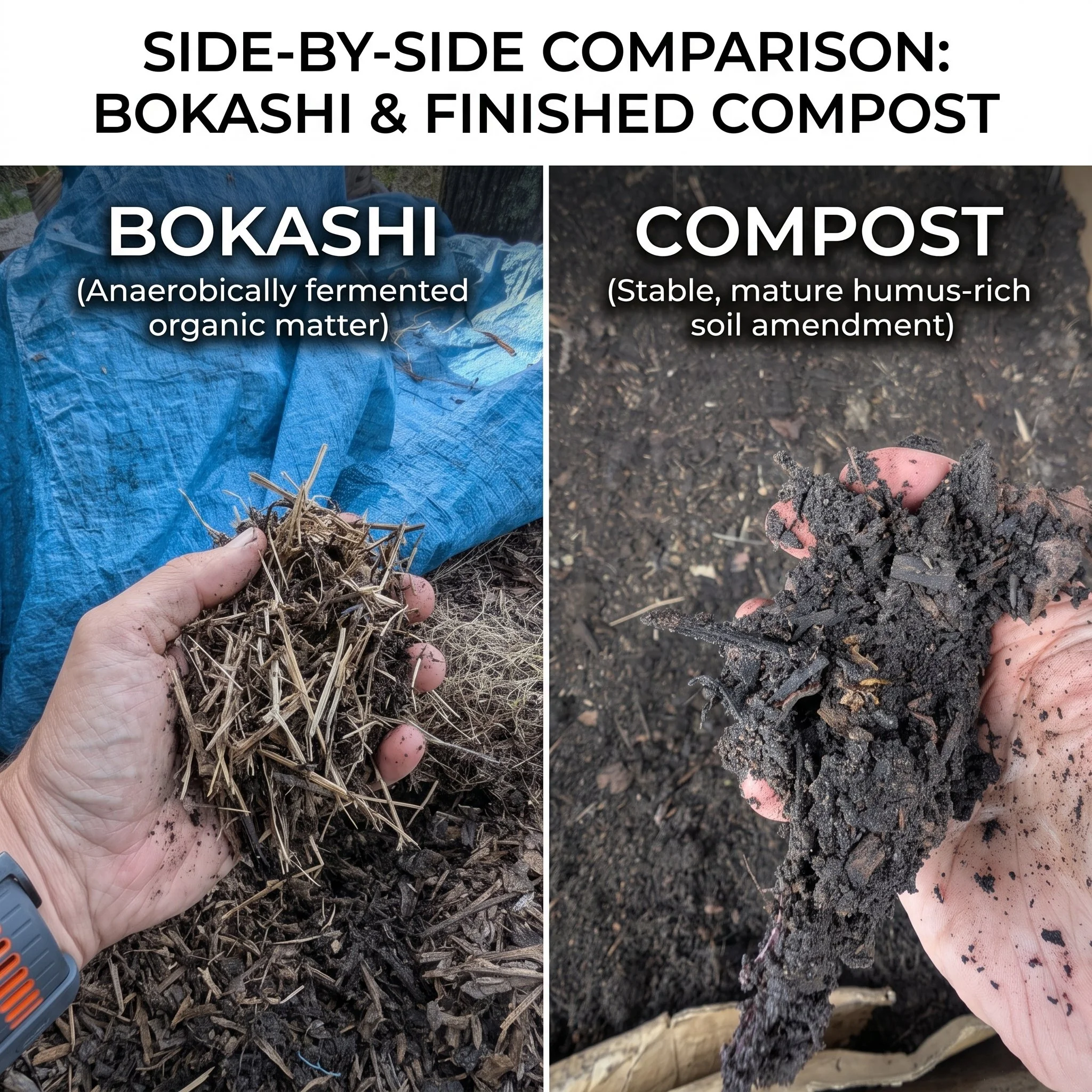
Bokashi and mature compost should not necessarily be viewed as competitors. Fermentation retains more readily degradable organic material, while mature compost contains a greater proportion of stabilised organic matter.
One of the most useful findings in the research is that the familiar argument of Bokashi versus compost is probably too simplistic.
They are different materials doing slightly different jobs.
During conventional aerobic composting, microorganisms can break down up to 50% of the organic matter in the heap before that material reaches the field.
Bokashi works differently.
Because fermentation takes place under oxygen-free conditions, much more of the readily degradable organic material is preserved during the fermentation stage. That material then begins breaking down when it is introduced to the soil.
The researchers therefore found that Bokashi generally contained more labile organic matter, while green compost contained a larger proportion of stable organic matter.
In simple terms:
Bokashi can bring food for the soil biology.
Mature compost can bring more already-stabilised organic matter.
For a market gardener, that suggests a much more interesting strategy than deciding which one is "best".
The future may be about building systems which continually provide both.
Feed the biology while also building the long-term physical structure of the soil.
Five years started to change the soil
These weren't overnight results.
And that is perhaps one of the most important lessons in the whole project.
At the higher application rate of 50 tonnes per hectare, several changes became apparent after repeated applications.
Researchers recorded:
a small but statistically significant increase in organic matter on clay soils;
a shift towards a more favourable fungi-to-bacteria balance;
increases in bacteria- and fungus-feeding nematodes;
greater earthworm biomass;
increased levels of nutrients including potassium, nitrogen, magnesium and calcium; and
lower soil bulk density.
At the lower 10-tonne-per-hectare rate, researchers often observed similar trends, but they generally weren't statistically significant within the five-year study period.
That shouldn't necessarily be viewed as disappointing.
It tells us something important about regenerative soil management:
soil building is cumulative.
We often want a treatment we can apply in March and measure in June.
But changing the physical and biological characteristics of soil is a different proposition.
It can take years.
For someone establishing a market garden now, that makes the decisions made in years one and two incredibly important for what the soil may be capable of in years five, ten and twenty.
And what about water?
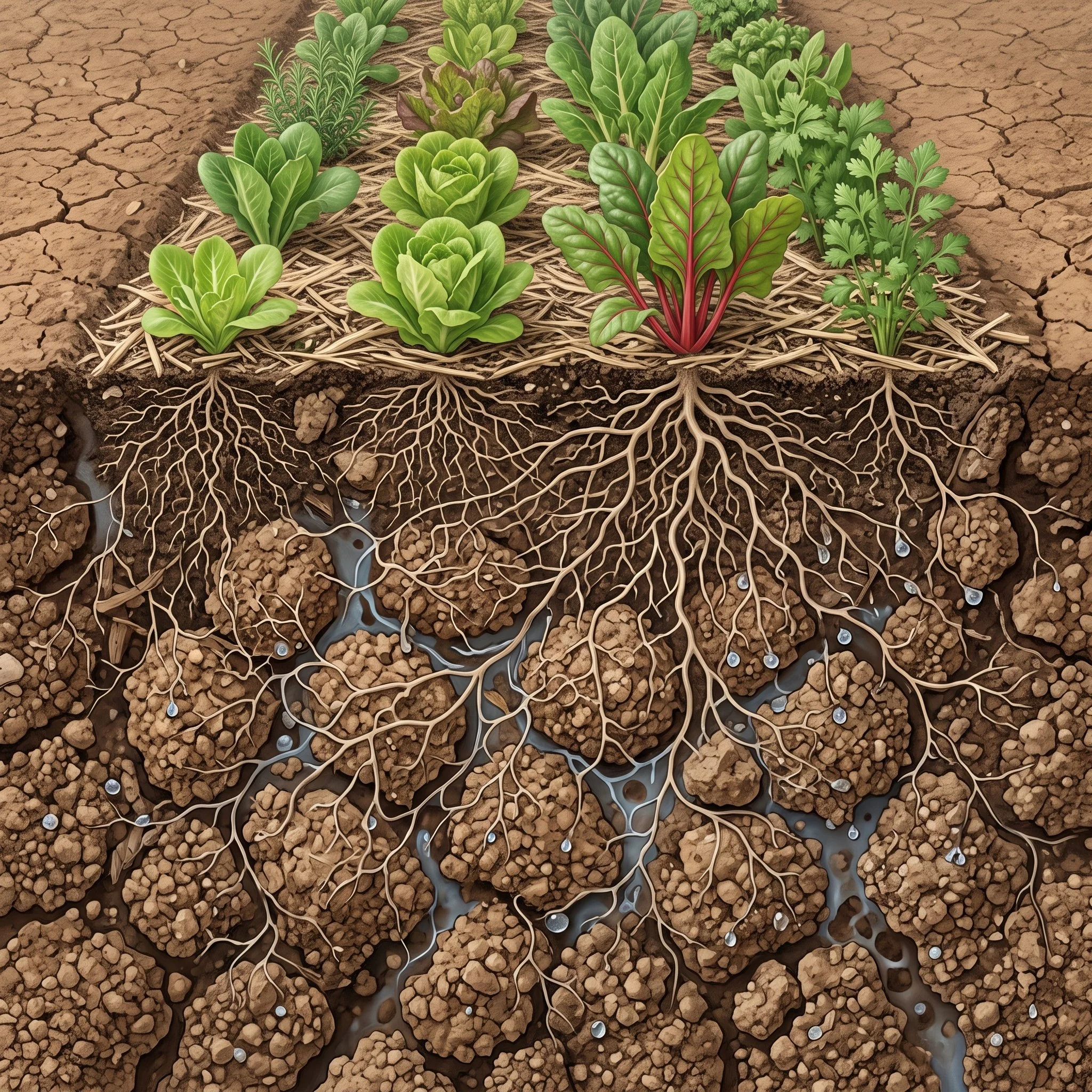
The Wageningen programme did not demonstrate a statistically significant increase in field water-holding capacity within the five-year research period. However, stable organic matter, aggregation and soil pore structure are fundamental to how soils store and move water.
This is where we need to be careful.
It would be very tempting to read the organic-matter results and claim:
"Bokashi has been scientifically proven to increase drought resistance."
That isn't what this research found.
After four years, the controlled field trials had not measured a significant improvement in water-holding capacity.
Applying Bokashi as a mulch also produced no measurable change in infiltration rate within six months.
However, treated soils did show lower bulk density, and in the practical pilot sites the treated soils held somewhat more water under wet conditions than untreated comparison sites.
The researchers concluded that the study period may simply have been too short to detect the longer-term changes they were looking for.
That distinction matters.
What the research gives us isn't a miracle drought treatment.
It gives us something more useful:
a mechanism and a direction of travel.
We know stable organic matter contributes to aggregation and pore space.
We know those structures influence both water storage and drainage.
We know maintaining organic matter is therefore fundamental to resilient soil.
And we now have five years of field research showing that locally produced organic soil improvers can contribute towards that soil-building process.
For growers facing hotter, drier summers, waiting until a drought arrives before thinking about water is already too late.
Drought resilience starts years earlier.
The underground livestock are changing too
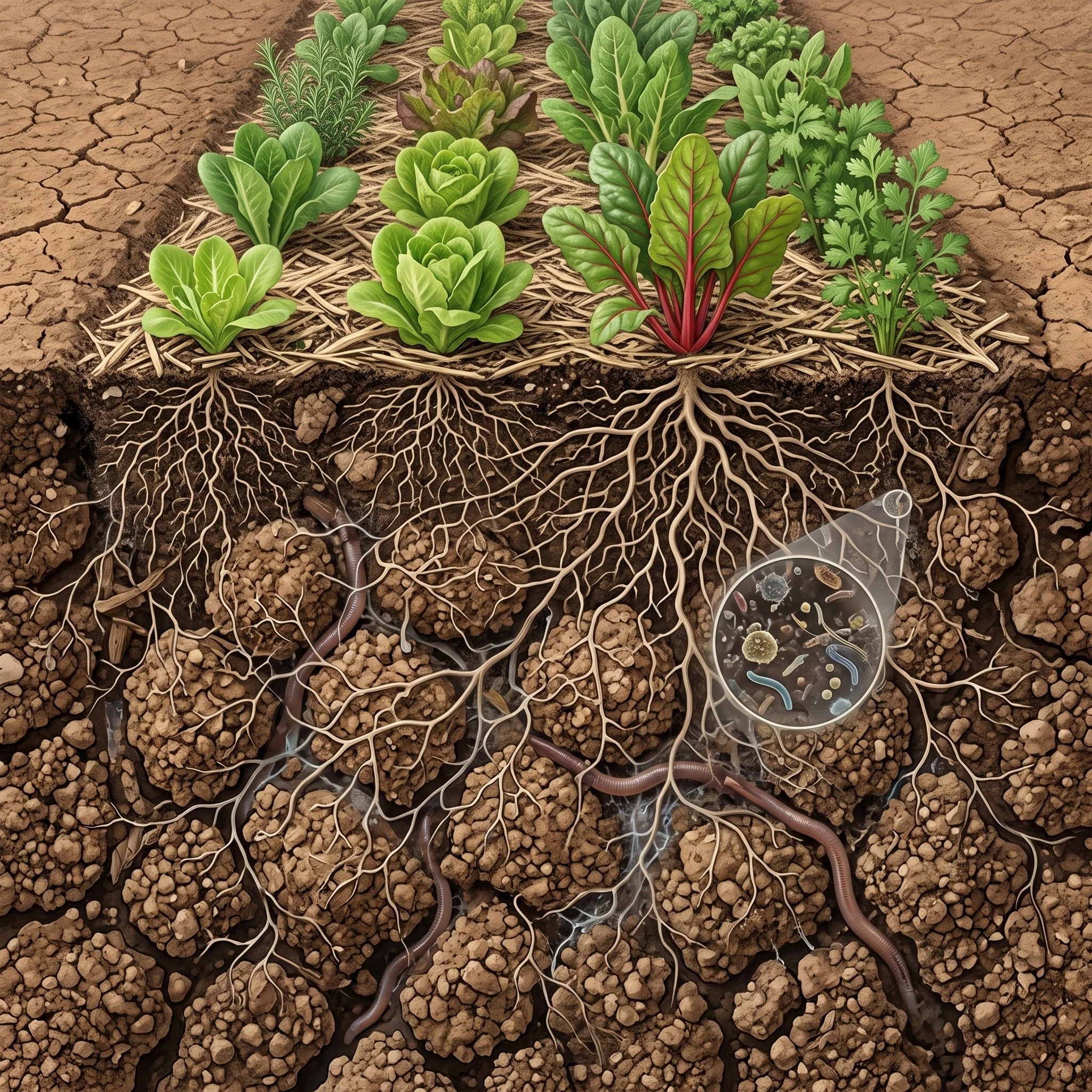
Perhaps one of the most fascinating parts of the research happened below the level we can see.
Bokashi and compost treatments sometimes produced a higher fungi-to-bacteria ratio than conventional fertilisation treatments.
The proportion of mycorrhizal fungi also increased following repeated high applications of organic soil improvers.
That matters because mycorrhizal fungi form relationships with plant roots, helping plants access water and nutrients in return for sugars produced through photosynthesis.
Researchers also found increases in nematodes that feed on bacteria and fungi.
These organisms form part of the soil food web responsible for processing organic material and cycling nutrients.
Even the earthworms told an interesting story.
In some trials there weren't necessarily more worms.
There was greater earthworm biomass.
In other words, the soil wasn't simply supporting a bigger population; it was capable of supporting more worm mass.
For a market gardener, this is a reminder that fertility isn't just something contained in a bag.
Some of the most important fertility infrastructure on the farm is alive.
But there is an important nitrogen warning
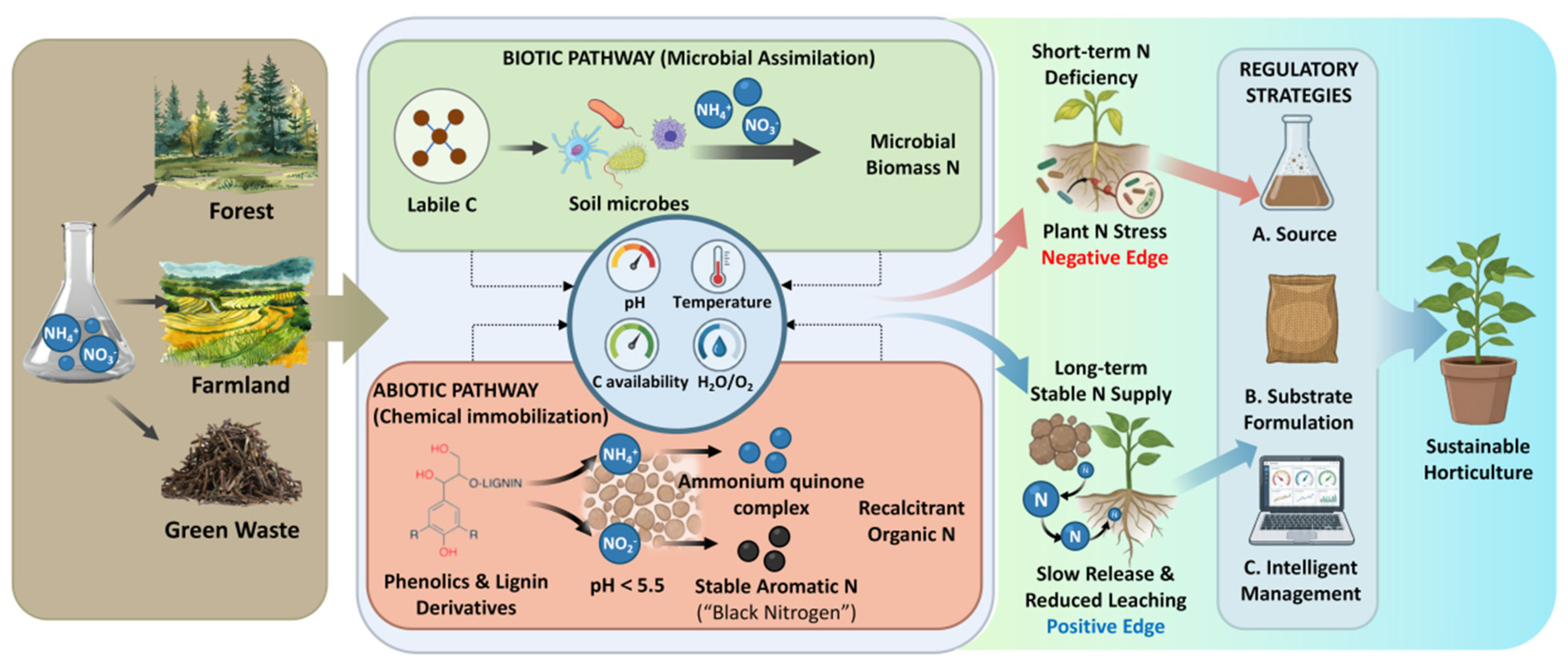
Organic matter is not the same thing as fertiliser.
This is another area where the Wageningen work deserves attention.
Many types of Bokashi made from grass cuttings had a relatively high carbon-to-nitrogen ratio.
When carbon-rich material enters the soil, microorganisms need nitrogen to process it.
For a period, those microorganisms can therefore take up mineral nitrogen that would otherwise be available to the crop.
This is known as nitrogen immobilisation.
In the high-application-rate trials, crop yields were consequently lower than the treatments receiving standard fertilisation.
But there's an important detail: the trial design did not add supplementary nitrogen to compensate for that temporary immobilisation.
The researchers specifically stress that Local Soil Improvers should primarily be considered soil builders, rather than direct replacements for nitrogen or phosphate fertilisers.
For vegetable growers, that's particularly important.
A lettuce, brassica or hungry squash crop doesn't care that you're improving the soil for 2030 if it runs short of available nitrogen in June 2027.
The two strategies have to work together.
Build carbon.
Feed biology.
But understand crop nutrition as well.
What about weed seeds from roadside material?
This is another understandable concern.
If we're suggesting that local grass, leaves and vegetation become valuable agricultural resources, nobody wants to introduce a new weed problem in the process.
The research here was encouraging.
Across practical samples, 71% contained either no viable seeds or only one viable seed per litre.
More importantly, correctly produced Bokashi performed particularly well.
Research by Van Hall Larenstein found virtually no viable seeds where Bokashi heaps had been correctly sealed.
Experimental work with broad-leaved dock, ragwort and Japanese knotweed found no germination following the fermentation treatment, including subsequent field testing over 21 days.
Again, the key phrase is correctly produced.
Process control matters.
Fermentation isn't simply throwing grass under a sheet and hoping for the best.
Is roadside grass really agricultural waste?
Maybe that is the biggest question this research asks.
Because once we start seeing organic material as a resource rather than a disposal problem, an enormous opportunity appears.
Roadside cuttings.
Leaves.
Park waste.
Market-garden crop residues.
Hedge trimmings.
Vegetable waste.
Material that may currently cost somebody money to collect, move or dispose of potentially contains carbon and nutrients that another piece of land desperately needs.
The Wageningen programme analysed 280 samples for heavy metals and found that nearly all complied with the relevant standards. Overall, 94% of the locally produced soil improvers assessed complied with the Dutch Fertilisers Act requirements used for comparison.
For physical contaminants, 98% were below the legal limit, although the study also makes clear that good collection and contamination control remain essential.
This is circularity becoming practical rather than theoretical.
Organic material leaves the landscape.
It is processed locally.
Then it returns to local soil.
The market garden of the future may look different
We often talk about the future of horticulture in terms of technology.
Sensors.
Automated irrigation.
Robotics.
AI.
New machinery.
All of those may have a role.
But one of the biggest technological upgrades available to a market garden may be considerably older:
better soil.
As drought becomes a more regular part of growing, market gardens may have to shift away from a system that asks:
How much water can I apply?
towards one that asks:
How much of the rainfall and irrigation I receive can my soil actually capture, store and make useful?
That means thinking beyond annual fertility.
It means keeping soil covered.
Returning organic residues.
Supporting fungi, bacteria, worms and the wider soil food web.
Building organic matter year after year.
And perhaps creating local partnerships where materials currently regarded as "waste" become inputs for food production.
The Wageningen programme doesn't give us permission to say that Bokashi will suddenly make irrigation unnecessary.
Quite the opposite.
Its caution makes the research more valuable.
Five years was not long enough for the researchers to prove a significant improvement in field water-holding capacity.
But within those five years, they were already measuring changes in organic matter, soil biology, nutrient status and bulk density.
The foundations were changing.
And perhaps that is the real lesson.
We shouldn't wait for drought before building drought-resilient soil
A market garden's resilience during the summer of 2031 could depend partly on what is being added to its soil in 2026.
That changes the economics of organic matter.
Grass cuttings aren't simply grass cuttings.
Leaves aren't simply leaves.
Crop residues aren't rubbish.
They are potential carbon sources.
Potential microbial food.
Potential soil structure.
And potentially part of a much more local circular growing system.
The future of market gardening may therefore involve a subtle but profound change.
Instead of continually feeding the crop and using the soil as somewhere to hold its roots, we start feeding and building the soil – and allow that soil to support the crop.
When the rain becomes unreliable, that distinction could become increasingly important.
Because the most valuable reservoir on a future market garden might not be the one sitting beside the polytunnel.
It might be the soil beneath our feet.
Source: Knowledge Programme for Circular Site Management – Summary of the Key Research Findings 2021–2026, Wageningen University & Research, with supplementary research from HAS Green Academy and Van Hall Larenstein University of Applied Sciences.
