
Anaerobic Digestion Isn’t the Only Future for Food Waste
Why Bokashi and soil-first systems matter more than ever
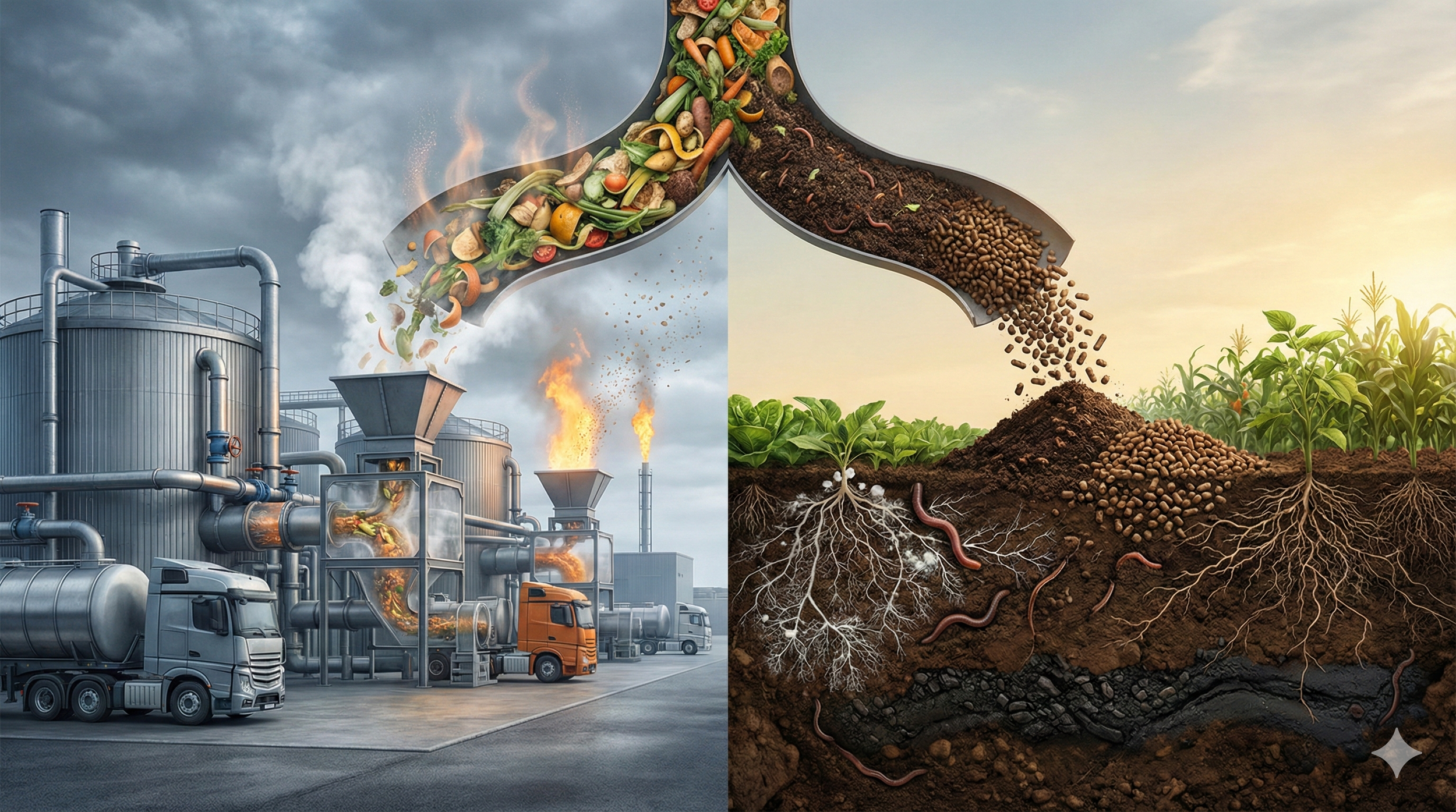
For many years, anaerobic digestion (AD) has dominated food waste policy and infrastructure investment in the UK. Large, centralised AD plants are often presented as the default solution — capturing methane, generating renewable energy, and diverting waste from landfill.
But as pressures on soil health, fertiliser costs, carbon retention, and nutrient efficiency continue to rise, a critical question is emerging:
Is energy recovery really the best use of food waste — or are we overlooking its role as a soil resource?
At Agriton, we believe food waste must be viewed not just as a fuel, but as a biological input. And that’s where Bokashi fermentation and soil-first systems fundamentally change the conversation.

Food waste: fuel or fertility?
Anaerobic digestion treats food waste primarily as an energy feedstock. In certain contexts, this makes sense. AD can:
Capture methane
Generate renewable energy
Reduce landfill disposal
However, these benefits come with trade-offs that are often underplayed:
Centralised infrastructure requiring long transport distances
High capital, planning, and operational costs
Digestate that can be difficult to manage and apply precisely
Significant loss of organic carbon that could otherwise build soil
In many systems, we are effectively burning soil fertility to make energy, then importing synthetic fertiliser to replace what has been lost.
That circularity deserves questioning.
Soil-first alternatives are already emerging
Recent work highlighted by Soil Systems shows that soil-first food waste pathways are not theoretical — they are already operating at scale.
Research into pelletised food waste demonstrates how organic waste can be:
Biologically stabilised
Converted into solid, uniform products
Stored, transported, and applied safely
Returned directly to land as a nutrient and carbon source
Rather than diluting nutrients into digestate, these approaches lock nutrients into solid forms that soils and crops can actually use.
This reinforces a principle long understood in regenerative systems:
Nutrients belong in soils — not pipelines.
Bokashi: protecting nutrients before they are lost
Bokashi fermentation takes this idea further by addressing food waste at the earliest possible stage.
Unlike aerobic composting or AD, Bokashi is an anaerobic fermentation process that:
Prevents nitrogen volatilisation
Suppresses methane formation
Retains carbon in organic form
Stabilises food waste before soil application
Crucially, Bokashi allows all food waste — including cooked food, dairy, and small amounts of meat — to be safely processed without odour, pests, or nutrient loss.
Instead of treating food waste as something to “get rid of”, Bokashi prepares it for soil.
From fermentation to soil regeneration
Once fermented, Bokashi-treated food waste becomes a powerful soil amendment when incorporated into soil systems, compost heaps, windrows, or soil blending processes.
Benefits include:
Higher nutrient retention compared to conventional composting
Faster integration into soil biology
Improved soil structure and aggregation
Increased microbial diversity and activity
Reduced dependency on synthetic fertilisers
Because Bokashi protects nutrients before they are lost, it complements other soil-first approaches such as pelletisation, composting, and mineral binding — acting as the front-end stabilisation step in a decentralised nutrient cycle.
Soil health shifts the priority
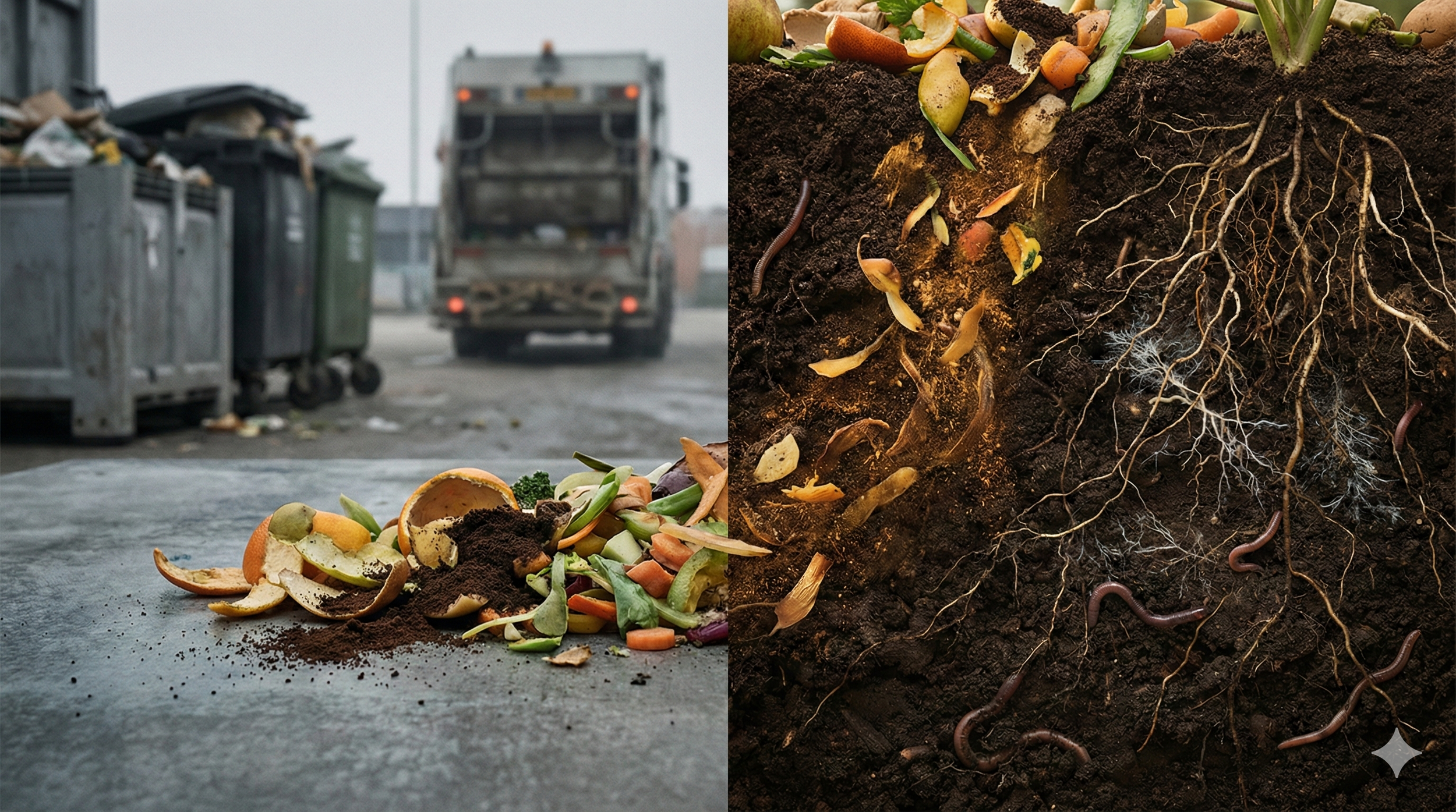
With rising fertiliser costs, declining soil organic matter, and increasing pressure on land, the key question is no longer:
“How do we dispose of food waste?”
It is increasingly:
“How do we return nutrients and carbon to soils without losing them along the way?”
From this perspective, anaerobic digestion should be seen as one tool, not the destination.
Bokashi and soil-first systems prioritise:
Nutrient retention over nutrient recovery
Soil biology over energy yield
Long-term fertility over short-term outputs
A broader, more resilient future for food waste
The future of food waste management will not be solved by a single technology.
It will require:
AD where energy recovery genuinely makes sense
Bokashi fermentation to stabilise nutrients early
Soil-based systems that build carbon and resilience
Decentralised models that keep value local
Food waste is not just a waste stream.
Handled correctly, it is a strategic input for soil regeneration.
At Agriton, Bokashi is not an alternative to soil systems —
it is the foundation that makes them work better.
