
Why Everything You Know About “Bad” Microbes Might Be Wrong

Soil Health, Market Gardening & the Power of Context in UK Horticulture
If you grow vegetables commercially in the UK — whether you’re running a no-dig market garden, an organic horticulture enterprise, or a regenerative growing system — you’ve probably been told the same story:
Some microbes are good.
Some microbes are bad.
Kill the bad ones.
But soil microbiology doesn’t work like that.
In regenerative horticulture, we’re learning something far more important:
Microbial behaviour is driven by context.
And when we change soil conditions, we change the biology.

Soil Health in UK Market Gardens: It’s About Balance, Not Sterility
In intensive vegetable production — salad crops, brassicas, roots, protected cropping — the pressure to “control” disease can be high.
Yet soil biology isn’t a battlefield. It’s an ecosystem.
Microbes often labelled as strictly pathogenic — such as certain Fusarium or Aspergillus species — exist in many UK soils as part of the broader microbial community.
Under stable conditions, with:
Active compost inputs
Strong fungal networks
Balanced pH
Good soil structure
Consistent carbon flow from roots
these organisms remain in ecological balance.
Problems arise when we create selection pressure.

The Hidden Cost of Chemical Shortcuts in Horticulture
High soluble nitrogen inputs, repeated disturbance, bare soil, and certain broad-spectrum agrochemicals alter microbial populations.
In UK horticultural systems this often leads to:
Reduced arbuscular mycorrhizal fungi (AMF)
Lower fungal-to-bacterial ratios
Weaker soil aggregation
Increased crop stress
Greater susceptibility to opportunistic pathogens
When we overfeed plants with soluble NPK, they reduce their natural microbial partnerships. In particular, AMF — critical for phosphorus cycling and drought resilience — decline.
We unintentionally disconnect the plant from its biological immune system.
DNA Is Not Destiny: Why Soil Microbes Adapt to Your Management
In soil science, especially within regenerative agriculture UK, there is growing awareness that:
Microbes adapt faster than we manage them.
Through horizontal gene transfer, microbial communities respond in real time to:
Oxygen levels
Redox potential
Chemical residues
Nutrient imbalances
Moisture stress
This is why two neighbouring market gardens, using different soil management strategies, can have completely different crop health outcomes.
It isn’t luck.
It’s context.
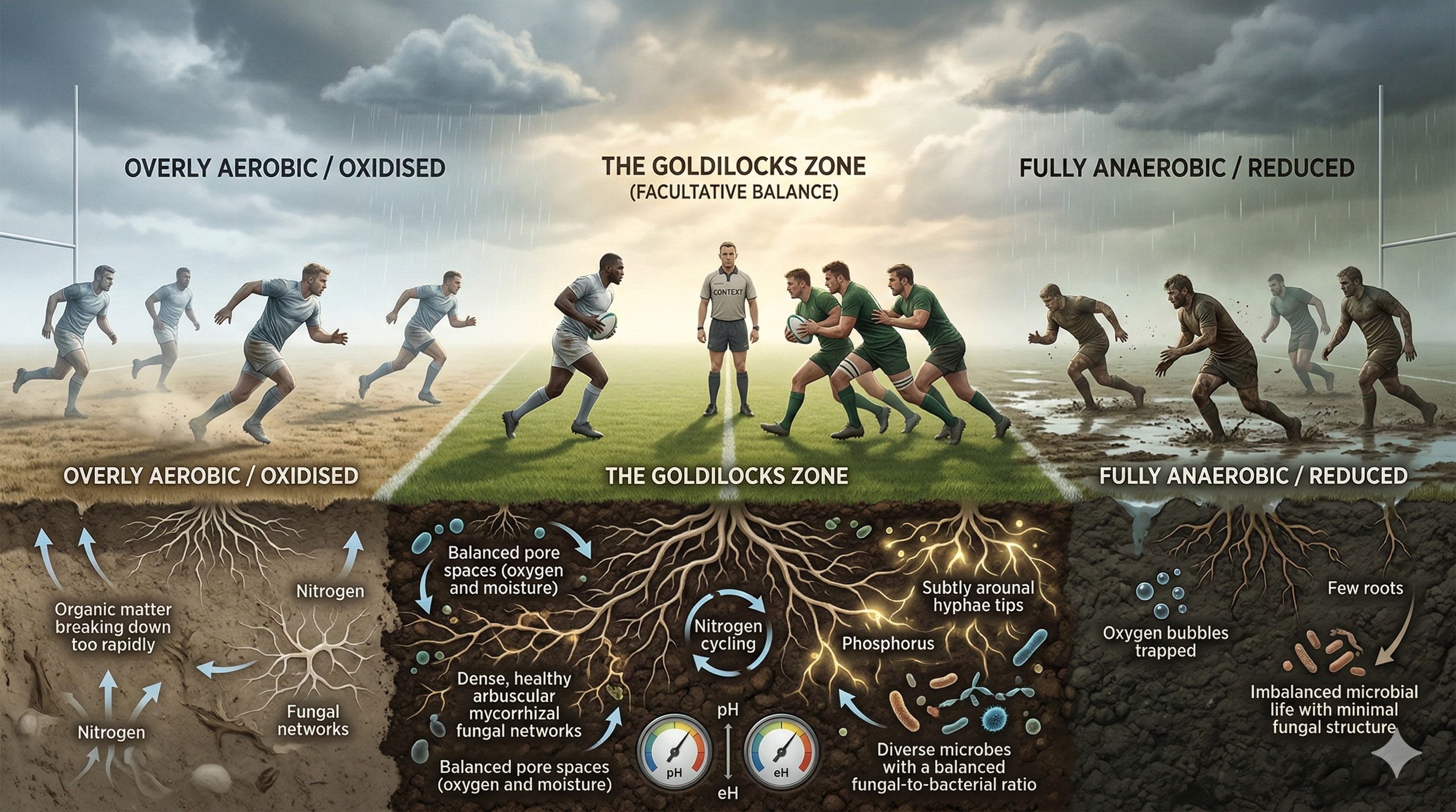
The Goldilocks Range: The Sweet Spot for UK Soil Biology
There’s a common narrative that soil must always be “fully aerobic”.
But resilient soils — particularly in compost-based, no-dig market garden systems — often operate in a facultative range.
This “Goldilocks” zone sits between:
Highly aerobic (oxidised)
Fully anaerobic (reduced)
When pH and redox potential (eH) sit within this balanced range:
Nitrogen cycling becomes more efficient
Phosphorus becomes biologically available
Fungal diversity increases
Natural microbial competition stabilises crop health
In UK horticulture, where rainfall patterns are unpredictable and soils vary dramatically (from sandy loams to heavy clays), maintaining this balance is critical.
Compost Is Not Just Organic Matter — It’s Biology
Not all compost is equal.
In market gardening, the difference between:
Mature, fungal-rich compost
Overheated, biologically inactive compost
Contaminated compost containing opportunistic spores
can define crop performance.
This is where soil microscopy becomes powerful.
Using brightfield and epifluorescence microscopy, growers can assess:
Fungal-to-bacterial ratios
Protozoa presence
Nematode diversity
Compost maturity
Root colonisation
For UK regenerative horticulture, this moves soil health from assumption to verification.
You’re no longer guessing whether your compost is biologically active.
You can see it.
From Pathogen Control to Context Management
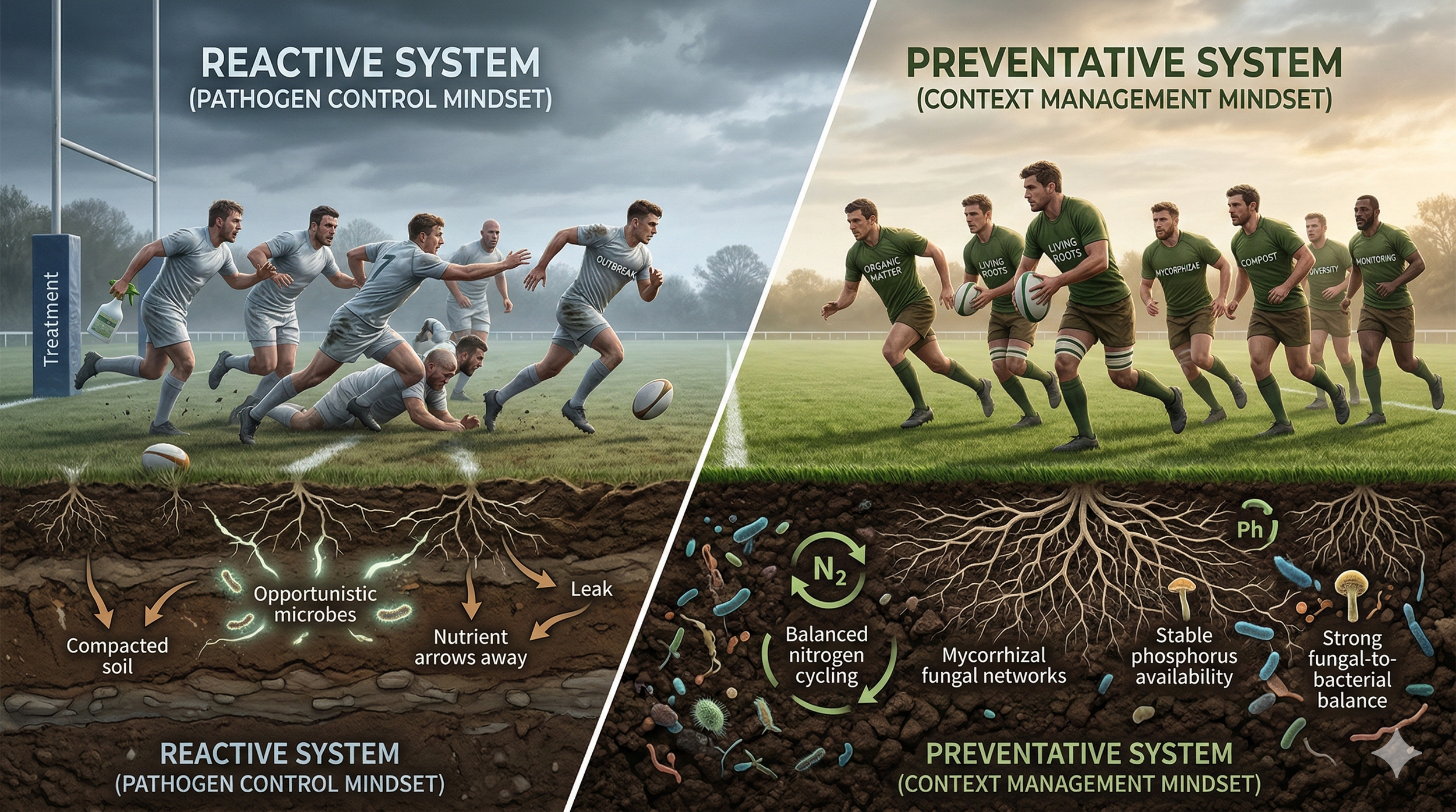
The traditional approach in UK crop protection has been reactive:
See problem → apply treatment.
The regenerative approach in market gardening is preventative:
Build biological resilience → reduce problems.
When you:
Increase soil organic matter
Minimise disturbance
Maintain living roots
Support mycorrhizal networks
Apply biologically active compost
Monitor microbial life
you shift the system away from opportunistic dominance.
Microbes aren’t inherently “good” or “bad”.
They respond to the growing environment you create.
Why This Matters for UK Growers Right Now
With:
Rising fertiliser costs
Increasing pesticide regulation
Soil degradation across intensive systems
Climate volatility
Consumer demand for nutrient-dense produce
UK horticulture needs resilience more than ever.
Healthy soil structure improves:
Water infiltration
Drought tolerance
Nutrient efficiency
Crop consistency
Carbon retention
This is not theory. It’s measurable soil health.

The Bigger Question for Market Gardeners
Whether you run:
A small no-dig vegetable enterprise
A regenerative mixed horticulture farm
A commercial salad operation
A protected cropping system
the real question is:
Are you trying to control biology —
or are you creating the conditions where beneficial biology dominates?
Because when you change soil context,
you change microbial behaviour.
And when microbial behaviour changes,
so does crop resilience.
If you’re working in UK regenerative horticulture or market gardening and are exploring:
Soil microbiology
Compost quality
Mycorrhizal restoration
Biological inputs
Soil microscopy
Redox and pH balancing
I’d be interested to hear what you’re seeing in your own soil.
The future of UK soil health may not lie in more inputs —
but in better context.
🌱
