
Making your own compost is one of the most useful ways to feed a no dig garden. Grass clippings, spent plants and kitchen scraps can all become resources for the next growing season.
But turning a heavy compost heap takes time, space and physical effort. And when homemade compost takes too long to become usable, gardeners can end up buying in material while their own waste sits waiting.
At Homeacres, we’re working with Charles Dowding to explore a practical question. Can no-turn systems produce useful material quickly enough to help gardeners cycle more of their own waste?
The trial compares three bays, each starting with 122 kg of material. Two will be left unturned. The third follows Charles’s approach and will be turned at least once before spreading.
Watch the Homeacres compost trial video
Building on Charles Dowding’s approach to compost
Charles’s no dig gardening puts compost at the centre of growing. Making good use of garden residues is already an important part of his work at Homeacres.
His composting method is also deliberately practical. Charles has documented making compost with a single turn, combining material from different parts of the heap and allowing it to continue breaking down before use.
That gives this trial a relevant comparison. We’re exploring whether removing that turning stage can still give gardeners useful material within a practical timescale. Charles’s own work already shows how much can be achieved with limited intervention. Read Charles’s account of making compost with one turn.
Three bays, three approaches
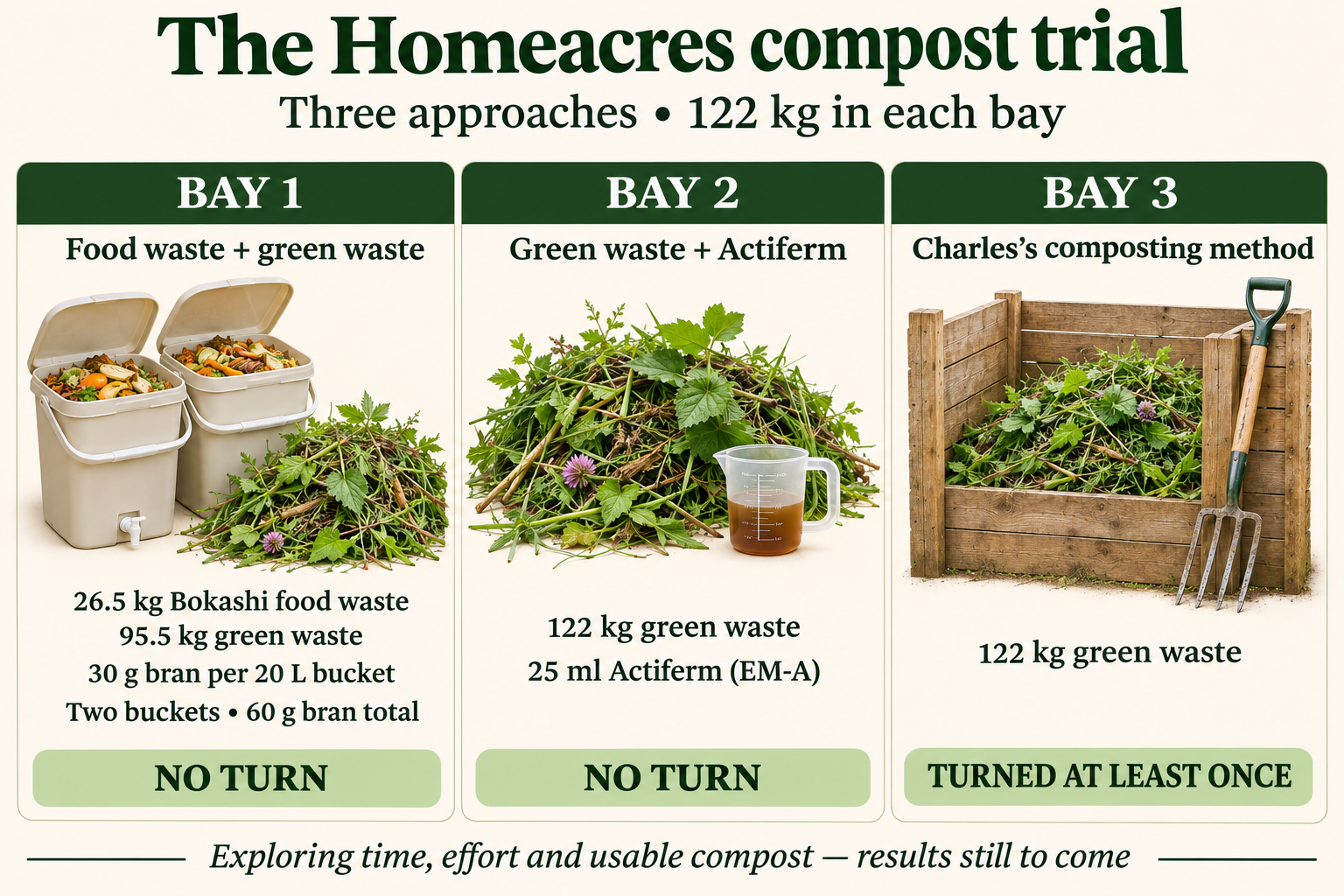
Each bay starts at the same total weight. That lets us compare what remains at the end, alongside the time and work involved.
Bay 1 — kitchen and garden waste together
Bay 1 combines two waste streams that many households already produce.
Two buckets provide 26.5 kg of food waste that has been fermented using Bokashi. This is combined with 95.5 kg of green waste, giving a total starting weight of 122 kg.
The bran rate used for this trial is 30 g per 20-litre bucket, or 60 g across the two buckets.
For someone who already has a suitable bucket system and garden waste, the additional input is small. The aim is to find out whether these everyday materials can work together in a system that needs no turning after construction.
The food waste has already gone through fermentation before entering the bay. We’ll need to account for that preparation time when comparing how long the complete process takes.
Bay 2 — green waste with Actiferm
Bay 2 contains 122 kg of green waste with 25 ml of Actiferm added. Actiferm is activated Effective Microorganisms, also known as EM-A.
This bay will also remain unturned.
It gives us a straightforward garden-waste approach to observe alongside Bay 1. We want to see how the material changes, how evenly it breaks down and when it becomes suitable for its intended use.
The dose recorded here describes this particular trial. Application guidance needs to take account of the material, its moisture and how the inoculant is distributed.
Bay 3 — Charles’s composting method
Bay 3 starts with 122 kg of green waste and follows Charles’s approach, including at least one turn before spreading.
It provides the practical benchmark for comparing the two unturned bays. We’ll be looking at the finished material as well as the effort required to get there.
How does this compare with cold composting?
Leaving a well-balanced heap to break down without turning is already an established option. Cold composting can suit gardeners who have space and are happy to wait.
Its main difficulty is timing. The RHS gives a broad range of six months to two years for garden compost to reach maturity, depending on conditions. Small heaps, cool weather and the mix of ingredients can all affect progress. That range describes garden composting generally, so it shouldn’t be treated as a fixed timetable for every cold heap. Read the RHS composting guide.
Moisture and structure matter too. Wet, compacted material can restrict the air needed for aerobic decomposition. Dry pockets and coarse stems can remain while softer ingredients break down around them. Turning helps redistribute those materials, but adds work.
Winter brings another complication. Lower temperatures slow decomposition, and the RHS advises keeping winter turning to a minimum to avoid losing heat. Read the RHS guidance on winter composting.
This is where the Homeacres trial becomes interesting. Can fermented food waste or an added microbial inoculant help create a useful, predictable no-turn system?
That is a question the trial needs to answer.
What we still need to learn
We’re interested in several practical outcomes.
Time to use. When is each bay suitable for spreading, and how much preparation time came before it?
Material retained. How much usable material remains from the original 122 kg?
Consistency. Are there wet pockets, dry areas or recognisable pieces that need longer?
Work involved. How much time goes into preparation, building, turning and handling?
Performance in the garden. How does the material support the following crop?
The comparison also has limits. Bay 1 contains food waste, so its starting composition differs from the two green-waste bays. Equal weight doesn’t mean equal moisture, nutrient content or dry matter.
Likewise, a heavier finished heap could simply contain more water. Weight measurements alone won’t establish carbon or nutrient retention.
With one bay per approach, this is an exploratory demonstration. It can reveal useful patterns and guide further trials, while leaving questions about repeatability across seasons and different gardens.
We also need to distinguish the stages of the process. Fermented material continues to change after fermentation, and suitability for spreading needs to be assessed. Adding Actiferm to green waste alone doesn’t establish that the whole bay has undergone Bokashi fermentation.
Can we rely more on the waste we already have?
The ambition is simple. Make better use of what comes out of the kitchen and garden, reduce the work involved and bring that material back into growing.
If an unturned system produces suitable material within a useful timescale, it could help gardeners reduce the amount of compost they need to buy. How far that goes will depend on how much waste they generate and how much compost their beds need.
For now, the Homeacres trial gives us three approaches to follow and some honest unknowns. We’ll share what happens as the materials develop, including what works, what needs longer and what we would change next time.
