
What if the organic materials we routinely throw away could become the foundations of a more resilient local food system?
On Friday 20 November 2026, Agriton UK joined Sustainable South Hams at School Farm CSA in Dartington, near Totnes, Devon, for a practical Bokashi composting workshop exploring how we can rethink food waste, garden waste and the role of microorganisms in building healthier soils.
Delivered by Martyn Richards, Agriton UK's Regenerative Living & Landcare Consultant, the workshop formed part of Sustainable South Hams' Compost for Nature programme, bringing together gardeners, growers, community composters and environmental organisations.
From small kitchen Bokashi buckets to larger no-turn green waste composting systems, the day explored practical ways to keep organic matter, carbon and nutrients within our local growing systems.
But this workshop was about much more than Bokashi.
It was about changing our relationship with waste.
Working Together to Build More Resilient Communities
Sustainable South Hams (SusSH) is helping communities connect, share knowledge and develop practical solutions to environmental challenges across South Devon.
Its Compost for Nature programme demonstrates the importance of making composting knowledge accessible, regardless of someone's experience, available space or budget.
Hosted at School Farm CSA, a community-supported agriculture project on the Dartington Estate, the workshop provided the perfect environment to explore the connections between composting, soil health, local food production and community resilience.
The event brought together people from Devon, Somerset, Sussex, the Forest of Dean and even the Scottish Borders.
Although everyone arrived with different experiences and challenges, there was a shared interest in learning how we can make better use of the organic resources already available to us.
What Is Bokashi Composting and Why Is It Different?
Bokashi is a Japanese term commonly translated as fermented organic matter.
Unlike conventional aerobic composting, which relies on oxygen to support decomposition, Bokashi uses fermentation within a low-oxygen environment.
Effective Microorganisms (EM®), including lactic acid bacteria and yeasts, help drive this fermentation process.
Rather than attempting to replace traditional composting, Bokashi offers another biological tool that can work alongside existing composting methods.
During the workshop, we explored:
The differences between aerobic and anaerobic composting.
The role of microorganisms in processing organic matter.
How fermentation can help preserve organic materials and nutrients.
How Bokashi can complement existing composting systems.
The potential to reduce labour through no-turn composting.
How we can keep more organic resources within our gardens and communities.
Understanding these biological processes allows us to make more informed decisions about how we manage different organic materials.
Discover more about Bokashi food waste fermentation.
No-Turn Composting: Making Better Use of Garden Waste
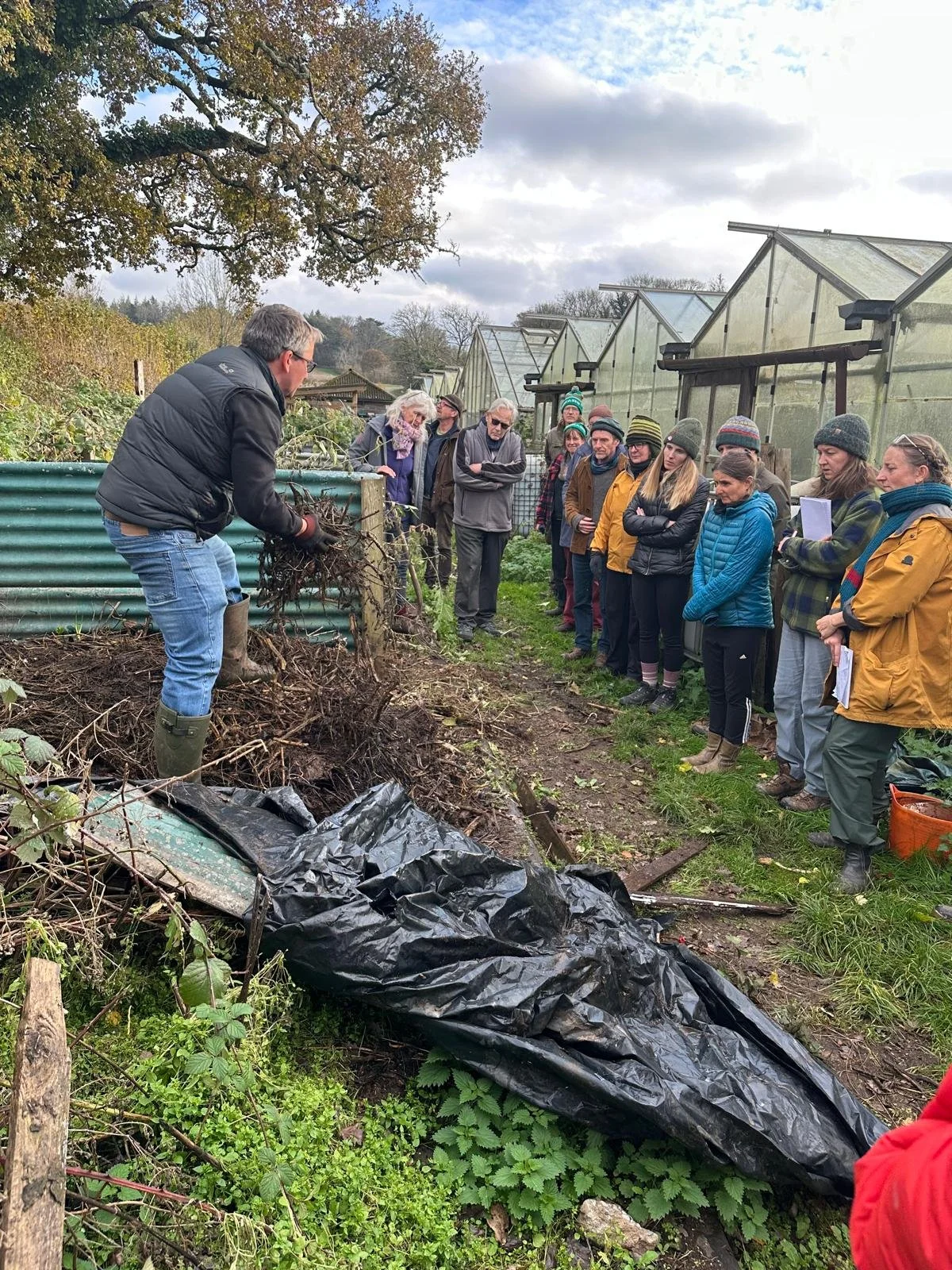
One of the most popular elements of the workshop was exploring how Bokashi can be used to process larger quantities of green waste without regularly turning a compost heap.
Grass cuttings, leaves, plant residues, weeds and other suitable organic materials can be processed through controlled fermentation.
By managing the moisture content, material composition, microbial inoculation and oxygen levels, we can create the conditions needed for green waste Bokashi.
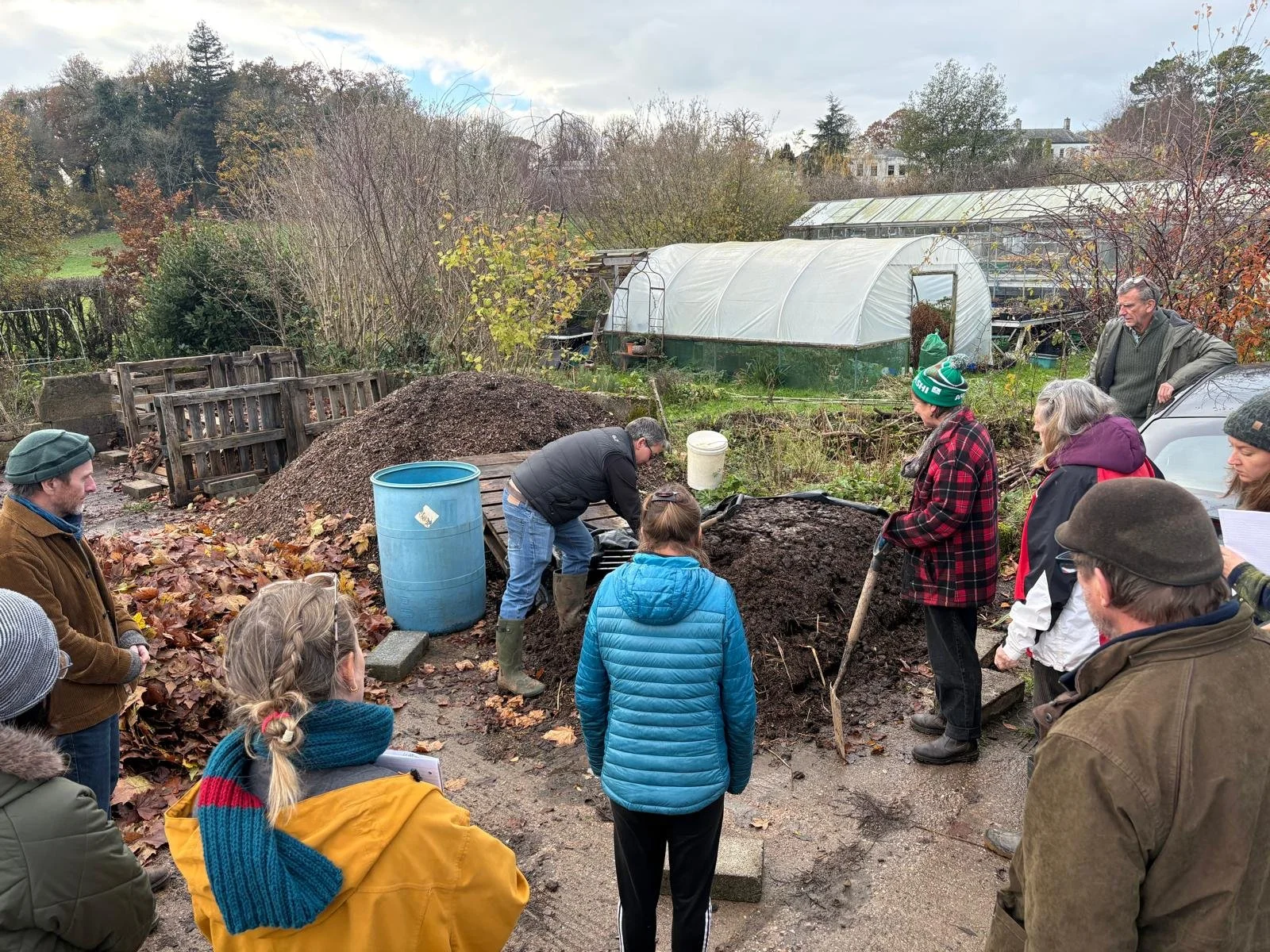
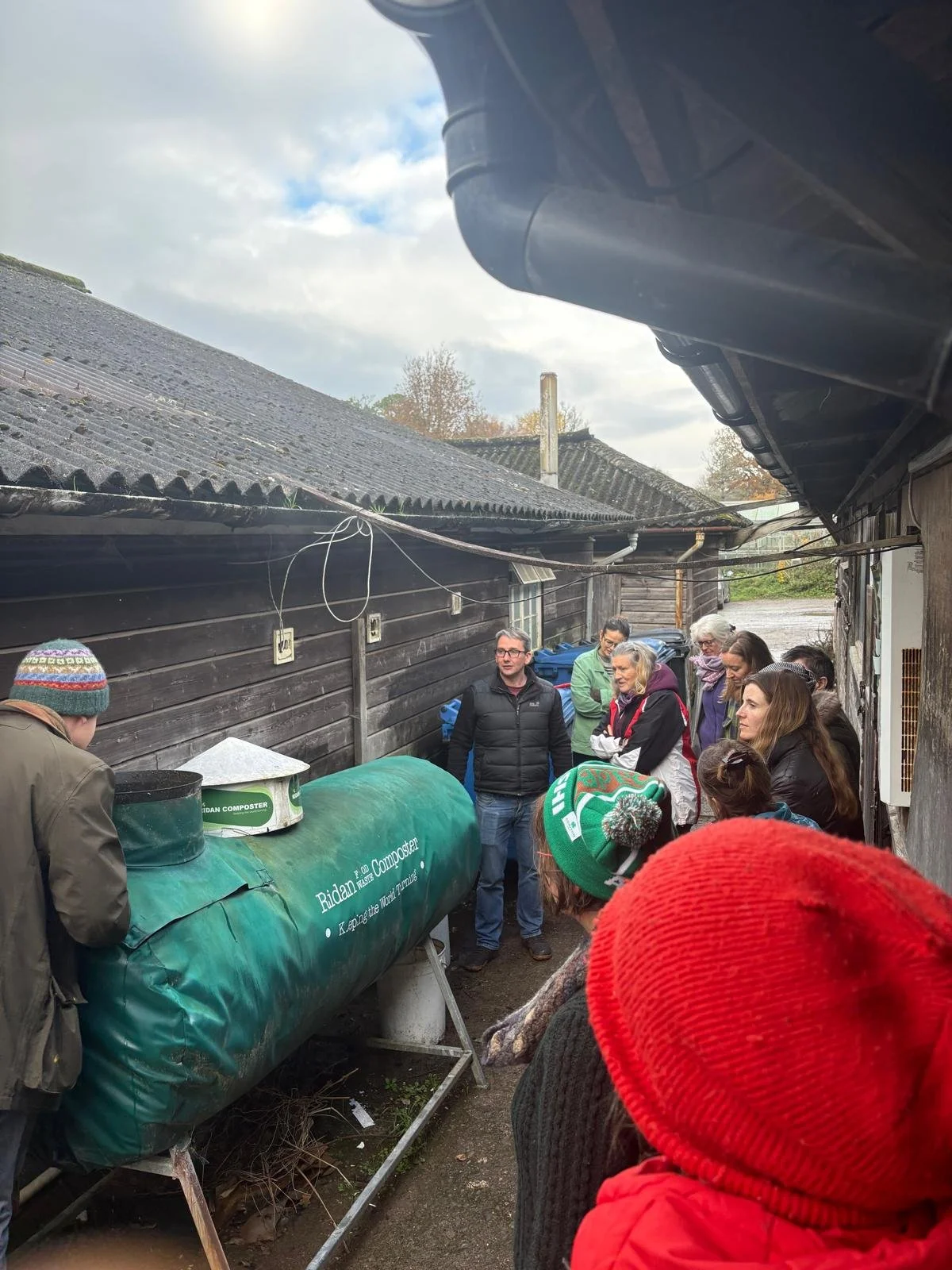
Participants had the opportunity to explore a practical demonstration heap at School Farm, connecting the theory discussed indoors with a working system outdoors.
For community gardens, allotments, market gardens and larger horticultural sites, this raises some interesting possibilities:
Reducing the physical labour associated with turning compost.
Processing organic materials directly where they are produced.
Reducing dependence on externally sourced compost.
Retaining organic matter for use within local growing systems.
Making composting more accessible to people with different physical abilities.
The fermented material can subsequently be used in appropriate mulching, soil incorporation or further composting systems, depending on its condition and intended use.
Learn how to make your own green waste Bokashi heap.
Bokoffee: Turning Coffee Grounds into a Valuable Resource
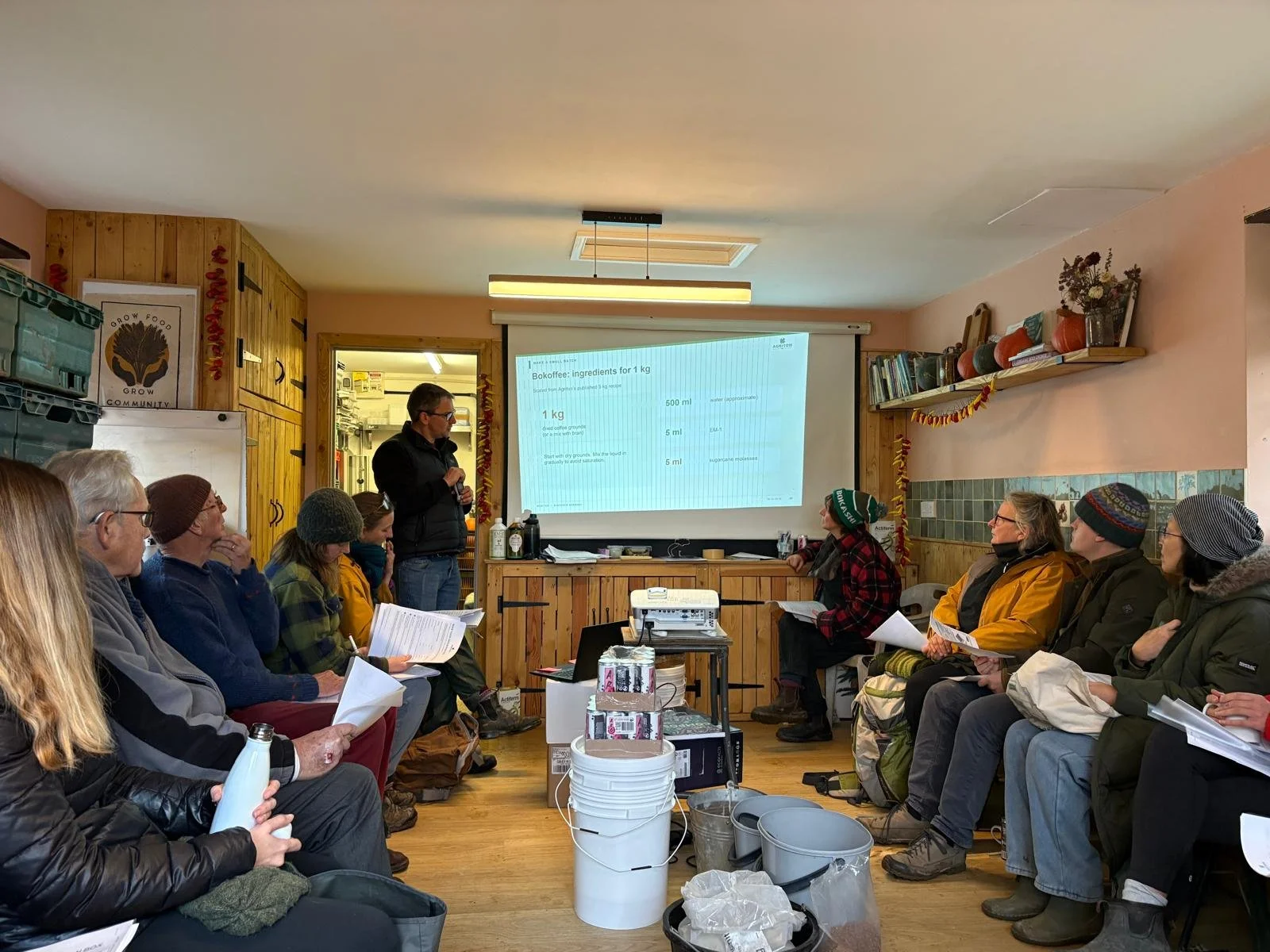
Another popular part of the session was learning how to make Bokoffee – a homemade Bokashi inoculant using recycled coffee grounds.
Coffee grounds are generated in significant quantities by households, cafés, restaurants and hospitality businesses.
Rather than treating them as another waste stream, we can explore how they can be used as a carrier for beneficial microorganisms through controlled fermentation.
The workshop introduced participants to the ingredients, equipment and principles behind creating their own microbial inoculants using coffee grounds, EM-1® and sugarcane molasses.
This approach opens up interesting opportunities for community composting groups to develop relationships with local cafés and hospitality businesses.
It also demonstrates that developing more circular composting systems does not always require expensive equipment or significant investment.
The knowledge to make better use of what we already have is often the most valuable resource.
Read our step-by-step guide to making your own Bokashi bran or Bokoffee.
Exploring Indigenous Microorganisms and Korean Natural Farming
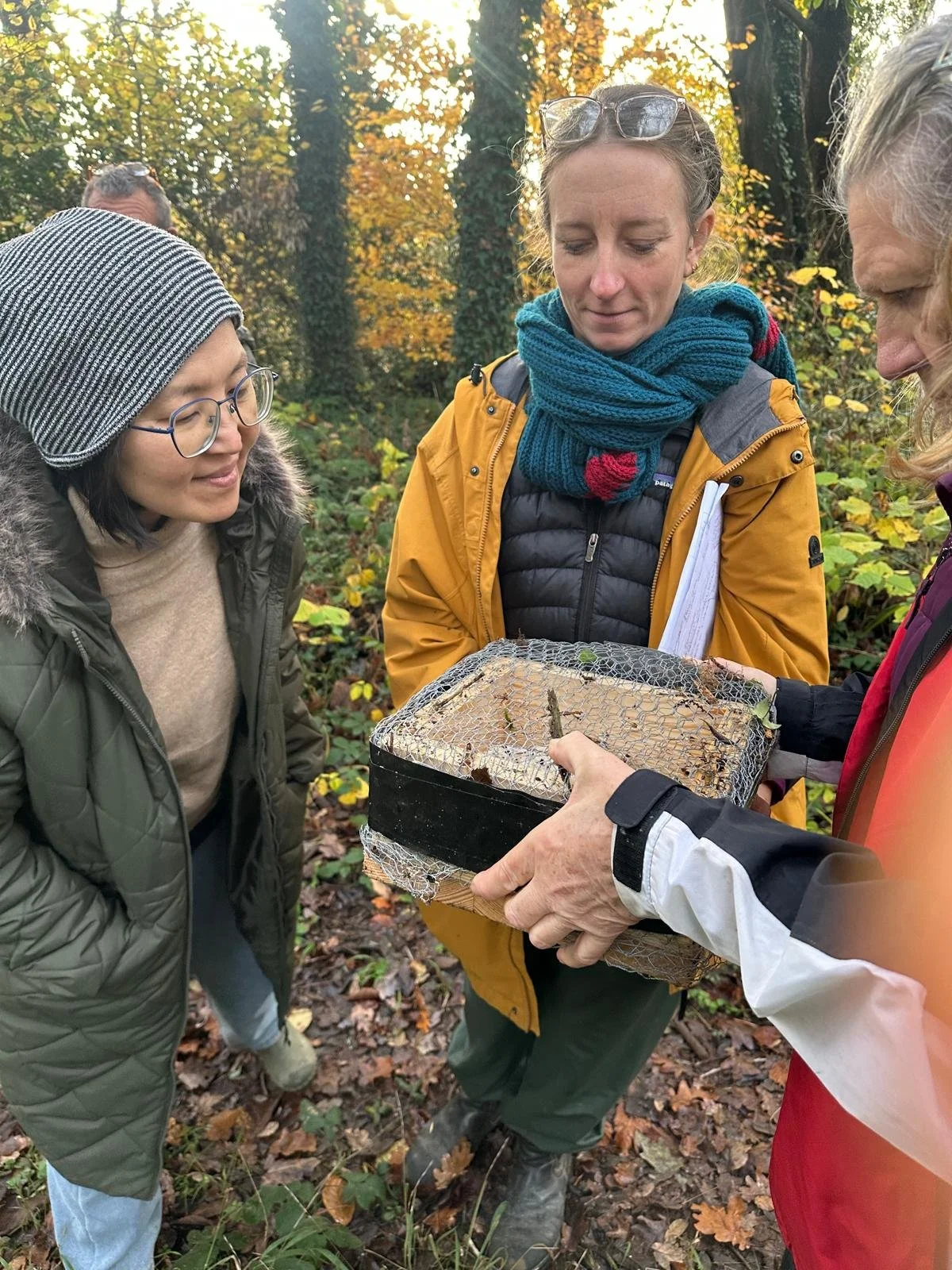
The workshop also introduced participants to Indigenous Microorganisms (IMOs), a practice associated with Korean Natural Farming (KNF).
Rather than looking at microorganisms as something separate from our growing systems, this approach encourages us to better understand the microbial communities already present within our local environment.
Participants explored the principles of collecting and cultivating indigenous microorganisms, alongside the differences between these approaches and formulated Effective Microorganism cultures.
The discussion included:
Indigenous Microorganism collection and cultivation.
Microbial diversity.
Effective Microorganisms and activated EM, also known as Actiferm or EM-A.
Homemade biological inputs.
The relationship between microorganisms, organic matter and soil fertility.
The feedback demonstrated a considerable appetite for further education in this area, with several participants requesting dedicated workshops on IMOs, fermentation and biofertilisers.
There is still much to learn about how different microbial communities interact and perform under different conditions, which makes practical experimentation and knowledge sharing particularly valuable.
Composting Shouldn't Be a Competition
Hot composting, cold composting, vermicomposting, Bokashi fermentation and other biological approaches all have a place within sustainable organic matter management.
One of the most important messages from the day was that aerobic and anaerobic microorganisms are not necessarily competing against one another. Both can play important roles at different stages of organic matter transformation.
We should be asking how these systems can complement each other rather than arguing about which individual method is best.
Agriton is currently exploring these questions through a practical trial with Charles Dowding at Homeacres in Somerset, comparing his established composting method with two alternative no-turn approaches.
The trial is investigating differences in organic matter retention and the potential value of the resulting materials within horticultural growing systems.
There are still plenty of unanswered questions, and that is precisely why we are undertaking the trial.
Read more about the Charles Dowding and Agriton no-turn composting trial.
What Did the Workshop Participants Think?
Following the event, Sustainable South Hams collected feedback to understand what participants found most valuable and how future educational sessions could be developed.
The results were incredibly encouraging.
9.3 out of 10 – average workshop usefulness rating.
Seven participants awarded the workshop 10 out of 10.
All 12 respondents rated the workshop at least 8 out of 10.
Several participants requested longer workshops and additional practical learning opportunities.
Among the feedback received were the following comments:
“Fabulous course, generously given.”
“Brilliant. Loved the energy and resources. Thank you! Please do more!”
“Great course and facilitator.”
“Thank you so much for a great time.”
Participants particularly valued learning about green waste Bokashi, no-turn compost heaps, homemade microbial inoculants, community-scale composting and the science behind different composting processes.
There were also some excellent suggestions for future sessions, including using microscopes to explore microorganisms, dedicated IMO workshops, more practical demonstrations and discussions around community composting regulations.
Education should never be a one-way conversation. The feedback helps us understand where more support is needed and how we can continue developing these learning opportunities together.
Connecting Community Composting Projects Across the UK
Across the UK, there are already incredible examples of communities taking responsibility for their organic resources.
At Agriton, we are fortunate to work alongside a growing network of gardeners, schools, growers, researchers and community organisations exploring different ways of closing the loop.
These include:
Charles Dowding at Homeacres: Investigating alternative no-turn composting methods.
ARK at Egwood CIC: Exploring on-site food and green waste processing in Somerset.
Llanfoist Fawr Primary School, Monmouthshire: Combining Bokashi fermentation and a Ridan composter to process school food waste on-site.
Soil Squad CIC: Supporting community composting, food waste collections and education.
Compost Club: Exploring living compost, soil biology and community food waste recycling.
Gather Community Garden, Eastbourne: Developing composting knowledge and local food resilience.
National Trust, Lyme Park: Exploring alternative approaches to green waste management.
Northern Roots: Developing community-focused urban growing and regeneration.
Each project has its own challenges, opportunities and experiences.
By connecting these organisations and encouraging them to share what works, as well as what doesn't, we can avoid continually reinventing the wheel.
We can achieve far more through collaboration than we can by working in isolation.
Free Composting Resources and Educational Guides
At Agriton, we believe that knowledge should be shared.
Following the workshop, we provided Sustainable South Hams with a collection of educational resources covering composting, Bokashi fermentation, research, soil biology and community-scale organic waste management.
You can also access a range of free educational resources directly through our website:
Whether you're just getting started at home or developing a larger community composting project, we want to help you build the knowledge and confidence to develop a system that works for you.
20% Off – Not Just a Discount, a Difference
Supporting the organisations that are making a difference within our communities is something we feel passionately about.
Rather than simply offering another promotional discount, we wanted to create an opportunity to give something back to Sustainable South Hams.
Use discount code: SUSSH20
When you use this code at www.agriton.co.uk, you receive 20% off your purchases, and Agriton gives a further 20% commission, calculated on the discounted purchase value, back to Sustainable South Hams.
This provides an opportunity to support further environmental education, community workshops and local sustainability initiatives.
There is absolutely no expectation to purchase anything. Our educational resources are freely available, and we actively encourage people to reuse existing materials and explore DIY solutions wherever possible.
But when you do need something from Agriton, your purchase can help support an organisation making a positive difference.
Not just a discount. A difference.
From Waste Management to Local Food Resilience
Perhaps the biggest opportunity is to stop thinking about composting simply as a way of getting rid of waste.
When we process organic materials locally, we have the opportunity to retain valuable resources, support soil fertility, reduce dependence on external inputs and strengthen local food systems.
Imagine what could happen if more households, schools, community gardens, cafés and growers started working together to close these nutrient loops.
The resources are already around us.
What we need is the knowledge, confidence and collaboration to make better use of them.
A huge thank you to Melissa Harvey, Ben Bryant, Sustainable South Hams, School Farm CSA and everyone who attended and contributed to the workshop. Thank you also to Kate and Ben for capturing the day through their photographs.
At Agriton, we are always interested in supporting new community projects, educational workshops, research collaborations and practical composting trials.
If you're developing a community composting system, working with a school, managing a market garden or simply looking to make better use of your own organic materials, please get in touch.
Let's stop talking about waste and start recognising the resources we already have.
Agriton UK – Working together for a sustainable future.
